



































The Romanian Plum Miracle in Our Orchards: Meet the ‘Agent’ Variety
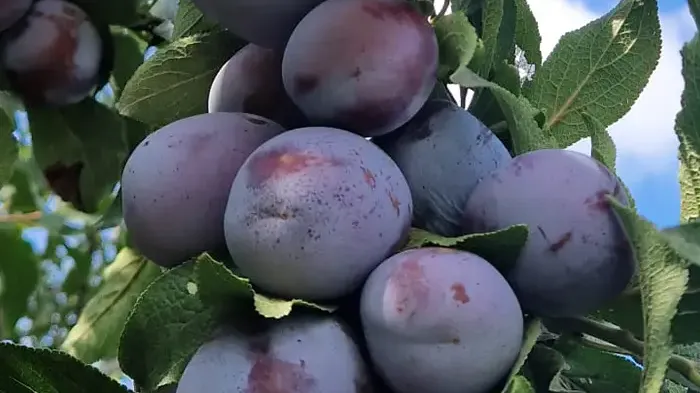
The Romanian Plum Miracle in Our Orchards
Why the world is going wild for Balkan plums, and what secret does the ‘Agent’ variety hold?
Close your eyes and picture the late Balkan summer. The sun rests on rolling hills, the heavy, sweet scent of ripening fruit hangs in the air, and from a nearby farmyard comes the soft bubbling of a copper cauldron. This is Romania, a country where the plum is far more than ordinary fruit. It is a national treasure, a piece of cultural heritage and a cornerstone of the local cuisine.
But why should we, with our own rich fruit-growing tradition, reach for varieties from the Balkans? The answer lies in the long-term work of the breeders there.
1978 year of release of ‘Centenar’ and ‘Roman’ |
50–60 g fruit weight of ‘Centenar’, ‘Roman’ and ‘Carpatin’ |
75–100 g fruit weight of ‘Record’ |
approx. 30 g fruit weight of ‘Agent’ |
← Swipe the table sideways →
The Plum as a National Treasure
Romania has long been one of the world’s largest plum producers. The reason is simple: the national spirit Țuică and the thick, dark plum butter Magiun demand fruit of the highest quality.
Two Romanian traditions
Țuică is the traditional plum brandy. Magiun is a thick, dark plum butter that is cooked for several hours without added sugar.
In Romania the plum is no ordinary fruit. It is a national treasure, cultural heritage and the foundation of the local cuisine.
To satisfy this national passion, Romanian fruit growers built up first-class research institutes. Names such as Pitești – Mărăcineni, Voinești or Vâlcea may sound foreign, but among fruit growers they are respected addresses. This is where varieties were bred that are now finding their way into gardens across Europe.
Blue Aristocracy: How Varieties Are Born
Breeding a new fruit variety is not a matter of a single season. It is the work of decades. Romanian scientists had a clear goal: to take the best of the old local varieties, which excelled in flavour, and combine it with modern requirements, namely large fruit, disease resistance and early bearing.
Take the famous Romanian variety ‘Tuleu Gras’. Its flavour is outstanding, but in the orchard it had its weaknesses. Breeders at the Pitești institute therefore crossed it with the English variety ‘Early Rivers’.
The Secret ‘Agent’ with Wild Blood
While varieties such as ‘Diana’ and ‘Roman’ were bred for large fruit and eating fresh, in 2004 the Pitești institute officially released a variety with a completely different purpose. It was given the fitting name ‘Agent’.
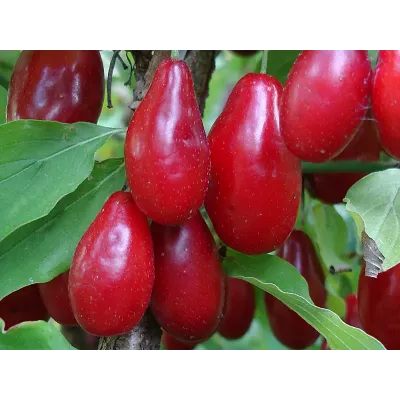
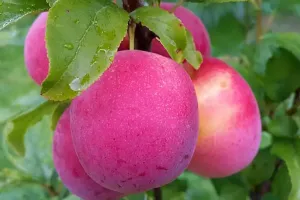
At first glance it goes against current trends. The fruit is not huge (around 30 g), and the skin is not the classic blue but an intense red-violet with distinctive speckling. So what makes it special?
The secret lies in its ancestry. ‘Agent’ was selected from a population with a strong genetic influence from Prunus domestica subsp. insititia. Behind this Latin name is the subspecies that includes the damsons.
These semi-wild, ancient varieties have smaller fruit, but they offer what large modern plums often lack: an intense aroma, a high dry-matter content and a spicy, sweet-sour flavour. That is why ‘Agent’ is excellent for processing: for drying, for jams and above all for spirits, to which it gives a distinctive, deep character.
What does “insititia” mean?
The subspecies Prunus domestica subsp. insititia covers plums with smaller fruit and a strong flavour (known in English as damsons). They stand closer to the original, semi-wild forms than modern large-fruited plums do.
A note on plum stones
The kernels inside plum stones contain amygdalin, from which hydrogen cyanide can be released in the body. Do not eat them and do not crush them into food.
Extremes You Have to Experience: From Giant to “Seagull”
The Romanian breeding programme also stands out for its variety.
Fruit Weight Compared
| ‘Record’ | 75–100 g |
| ‘Centenar’, ‘Roman’, ‘Carpatin’ | 50–60 g |
| ‘Agent’ | approx. 30 g |
The bars are scaled to a range of 0–100 g. For varieties with a weight range, the fill reflects the upper limit of the range. Only varieties whose fruit weight is known are shown.
← Swipe sideways →
Variety Overview
| Variety | Released | Parentage | Fruit weight | Characteristics |
|---|---|---|---|---|
| ‘Centenar’ | 1978 | ‘Tuleu Gras’ × ‘Early Rivers’ | 50–60 g | resistance to plum pox, heavy cropping |
| ‘Roman’ | 1978 | ‘Tuleu Gras’ × ‘Early Rivers’ | 50–60 g | large fruit, harmonious flavour |
| ‘Carpatin’ | 1982 | ‘Tuleu Gras’ × ‘Early Rivers’ | 50–60 g | large fruit, heavy cropping |
| ‘Diana’ | 1982 | ‘Early Rivers’ × ‘Renclod Althan’ | not stated | round shape, juicy flesh, early ripening |
| ‘Agent’ | 2004 | selection from a population influenced by subsp. insititia | approx. 30 g | red-violet skin, suited to drying, jams and spirits |
| ‘Record’ | 1983 | open pollination of a purple gage | 75–100 g | very large fruit, crisp flesh |
| ‘Pescăruș’ | 1979 | Count Althann’s Gage × ‘Wilhelmina Späth’ | not stated | mid-late, exceptionally frost-hardy, golden-yellow flesh |
← Swipe the table sideways →
Plum pox and choosing trees
Varieties described as resistant to plum pox tolerate the disease better, but they are not fully protected against infection. Buy trees from reliable nurseries that supply healthy, inspected planting material.
Conclusion
Growing fruit is no longer just about how many jars we fill for the winter. It is the joy of discovering new flavours, respect for nature and appreciation for the work of generations of breeders.
When you plant a Romanian plum in your garden, whether the giant ‘Record’, the plum-pox-resistant ‘Centenar’ or the wild-blooded ‘Agent’, you are not just planting a tree. You are bringing home a piece of Balkan fruit-growing history.
And when, in a few years, you pick the first sun-warmed fruit, you will understand why Romanian plums are so highly valued. Noroc! (Cheers!)
|
Plums and Fruit Trees for Your Garden Browse plum varieties and other fruit trees and shrubs in our shop. Choose by fruit size, ripening time and intended use. Visit the shop → |
Our Facebook Page Swap growing experience, ask about varieties and share your harvest on our Facebook page, home to a community of enthusiastic fruit growers. Talk to experts and be the first to read new articles. Visit our page → |
Related Products


