For most growers, a raspberry means a row of tall, floppy, thorny canes that have to be tied to a wire trellis and cut back every year. Breeding work over the past two decades has produced cultivars that have very little in common with that picture. Dwarf raspberries for containers, a raspberry trained as a small tree with a solid trunk, or a black-fruited cultivar bred for machine harvesting – each of them solves a different growing problem.
This overview brings together four cultivars that represent four distinct directions in modern raspberry breeding: 'Ruby Beauty®', 'Selena', 'Groovy®' and 'Raspberry Tower'. All four are protected by plant breeders' rights.
|
0.5–1 m
height of 'Ruby Beauty®'
|
13.7%
Brix of 'Selena' fruit
|
−35 °C
hardiness of 'Groovy®'
|
200 cm
height of the 'Raspberry Tower' “raspberry tree”
|
← Swipe the table sideways →
Four cultivars, four different answers
'Ruby Beauty®' – the first fully thornless dwarf raspberry
The cultivar came out of a joint breeding programme run by Plant & Food Research in New Zealand and the Northwest Plant Company in the USA. It was selected in 2001 under the code 'NR7' from a cross between the unpatented New Zealand selection HR101 (seed parent) and the well-known cultivar 'Willamette' (pollen parent). In Europe and the United Kingdom it is sold as 'Ruby Beauty®', while in the USA and Canada it is known as 'Raspberry Shortcake®'. The licence is held by Pacific Berries LLC.
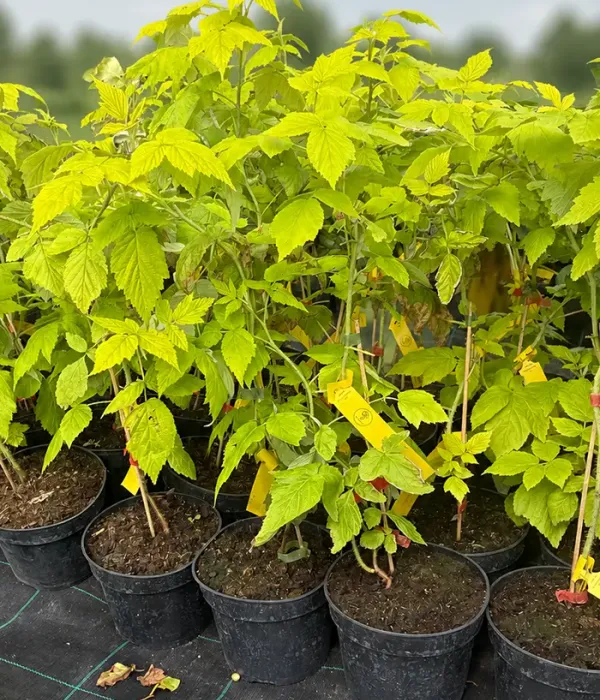
Plant and growth: the dwarf habit is genetically determined and stable. The plant grows slowly and reaches only 0.5 to 1 metre, most often 0.5–0.7 m in trials. The habit is compact and dense, the canes straight and upright, so the plant needs no support or tying in. The internodes are very short, typically 10–20 mm, and the canes are completely thornless. A single plant produces a large number of young canes, usually 20 to 50.
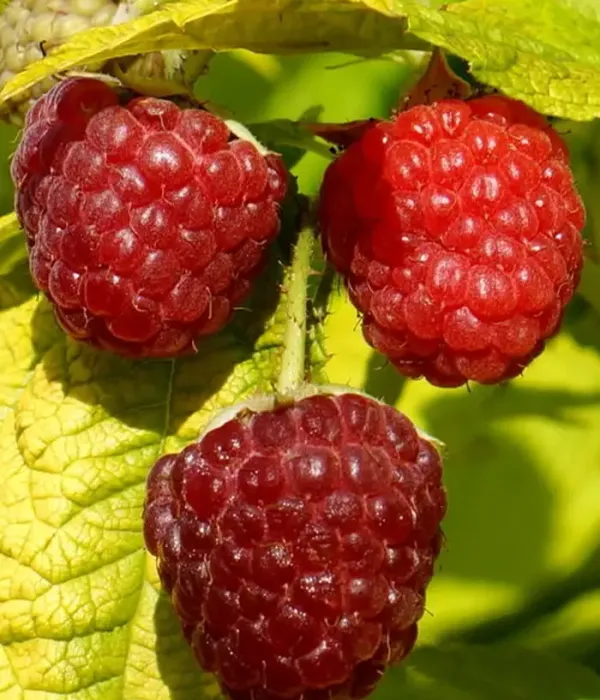
Fruit: medium to large, with an average weight of 3.9–4.7 g, which is more than some classic commercial cultivars such as 'Meeker'. The shape is oval to round and the colour light red. Compared with modern cultivars bred for shipping, the flesh is softer. The flavour is aromatic, with a lower sugar content of 8–9% Brix and moderate acidity of 2.1–2.2%.
Ripening and yield: a summer-bearing (floricane) cultivar that fruits on last year's wood. It ripens at a mid-early date, usually at the turn of July and August, and the picking season lasts around 30–32 days. Because of the dwarf habit the yield per plant is naturally lower – roughly 0.6–0.8 kg in trials, although according to the breeder a well-developed plant can produce up to 1.5 kg per season.
Hardiness and health: winter hardiness is average, quoted for USDA zone 7a, that is down to about −17 °C. In the cooler parts of Central Europe it therefore needs winter protection, or the containers should be moved into a cool but frost-free room. It shows resistance to raspberry bushy dwarf virus (RBDV) but is susceptible to mites.
'Selena' – a black raspberry bred for industry
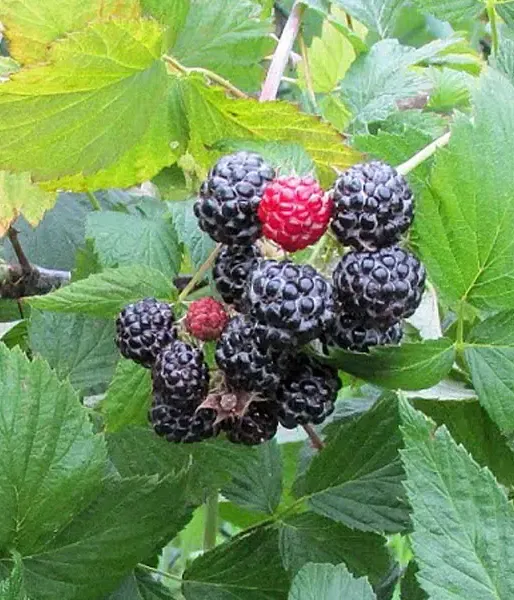
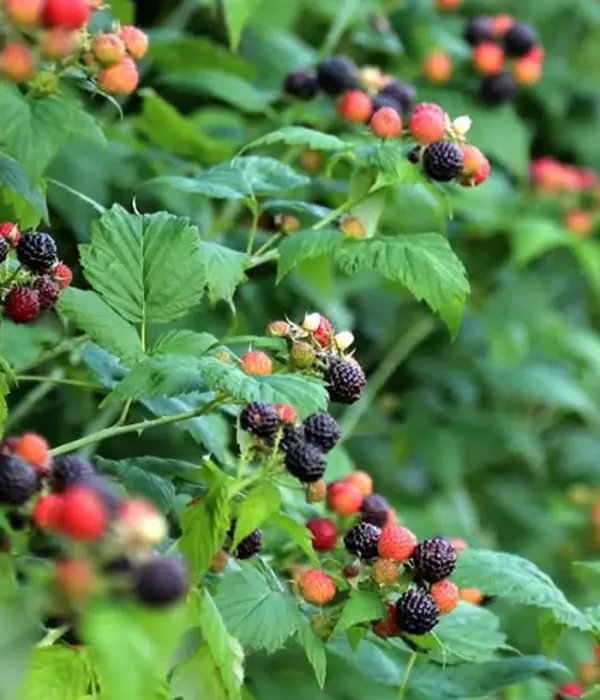
The black raspberry (Rubus occidentalis) is still uncommon in European gardens, even though it is a botanically distinct species with its own flavour and composition. 'Selena' comes from Poland, where it was bred within a project co-financed from POIR funds. It was tested under the clone number NR 1825501 and filed for legal protection with the Polish COBORU office under number S 392.
Plant and growth: vigorous, with firm and stiff canes. The structure of the plant together with its smaller leaves makes picking easier. Compared with older black raspberry cultivars, 'Selena' has one major advantage – the canes carry only a limited number of thorns.
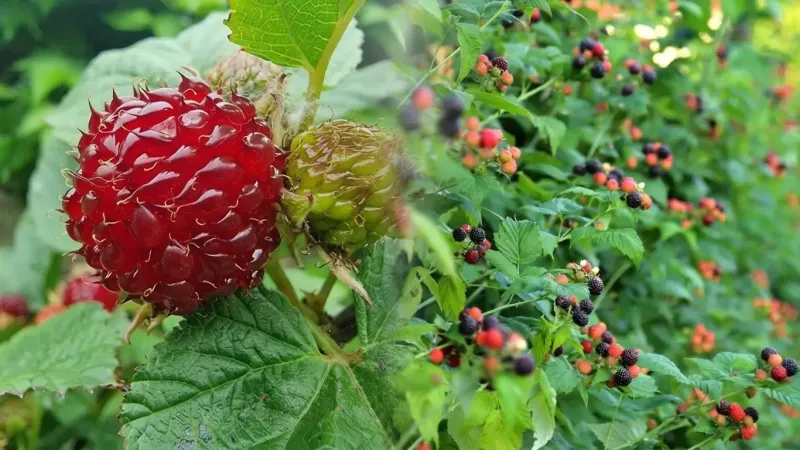
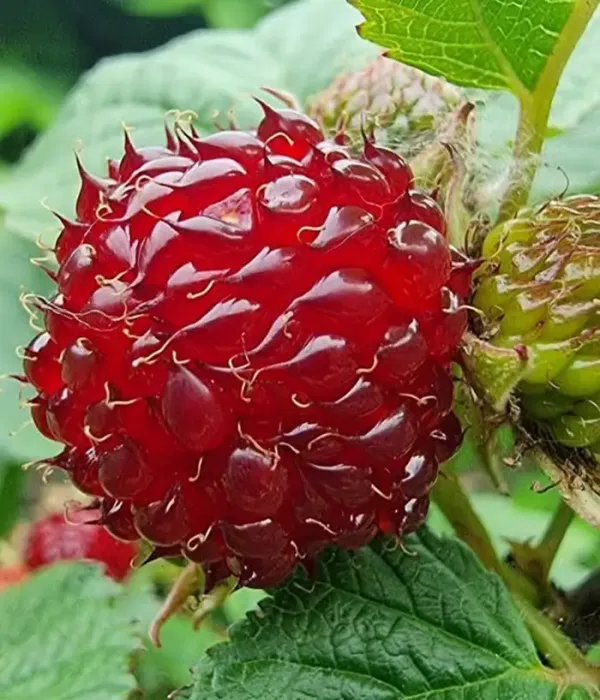
Fruit: large, with an average weight of 2.5 g, very glossy and well shaped, made up of small drupelets. The flesh is very firm. Sugar content is high, with Brix reaching 13.7%.
Ripening and yield: the cultivar is primocane-fruiting as well as floricane-fruiting – it bears on both last year's and this year's wood. The main crop on floricanes ripens from early to mid July, while the crop on primocanes starts ripening in early September. Picking is concentrated into a period of roughly five weeks. The average yield is 2.3 kg per plant.
Harvest and storage: the cultivar is expressly suited to machine harvesting. The fruit keeps a high post-harvest shelf life even after mechanical picking, which is decisive for industrial use.
Hardiness and health: in production trials the clone showed no cane damage from frost. It is highly tolerant of drought and of conditions with limited water supply. It has low susceptibility to aphids, to raspberry bushy dwarf virus (RBDV) and to fungal diseases of the canes and roots.
'Groovy®' – golden foliage and hardiness to −35 °C
This Dutch cultivar, raised by the breeder Jan de Boer (Vitis-Idaea B.V.), is legally protected within the European Union under number EU 57353, and propagation without a licence is prohibited. The publisher of the cultivar is Plantipp / SAPHO.
Plant and growth: dwarf and compact, with moderate vigour. At maturity, roughly after ten years, it reaches a height of 1 to 1.5 m and a width of 0.75 to 1 m. The habit is dense and bushy, and the canes are almost thornless.
Foliage: the most striking feature of the cultivar. At bud break in spring the leaves are orange-yellow, turning to a bright golden and light yellow-green in summer. Unlike many other plants with yellow foliage, the leaves of 'Groovy®' do not scorch in full sun.
Fruit: large, 2–3 cm across, bright red, creating a striking contrast with the golden foliage. The flavour is sweet, juicy and aromatic.
Ripening and yield: it is classified primarily as a summer-bearing, non-remontant cultivar that fruits on one-year-old canes. Under favourable conditions, however, the cropping period extends and fruit forms as soon as new canes develop. Picking runs from late June into September. The cultivar is productive and crops in the first year after planting.
Hardiness and site: winter hardiness is exceptionally high, withstanding frost down to −35 °C without damage. It prefers full sun to partial shade and a fertile, humus-rich, moist but well-drained soil.
Pruning: maintenance is very undemanding. At the end of winter or in early spring, the spent, dry canes should be cut back to ground level. For optimal growth, 7 to 10 young canes per running metre should be retained.
'Raspberry Tower' – a raspberry that grows like a tree
This cultivar, also known under the breeder's name 'Hararasp', belongs to the Korean raspberry (Rubus crataegifolius), a different botanical species from the common European and American raspberries (Rubus idaeus). It comes from Japan, from the breeder Toshikhiko Hara, and is legally protected.
Plant and growth: the most interesting feature of the cultivar. The plant forms thick, overwintering stems that can be trained into an upright small tree with a strong central trunk and a crown of fruiting branches. Growth is compact and narrow – it reaches a height of 175 to 200 cm and a width of only 60 to 100 cm. Thanks to the firm, stiff canes it needs no support or tying in whatsoever. The canes are covered with small thorns.
Flowering: from April to May, with white flowers that are very attractive to bees and butterflies.
Fruit: small, about 2 cm across, spherical and intensely red. Unlike ordinary, often matt raspberries, the fruit has a remarkably glossy surface. The flavour is good.
Ripening and yield: a summer-bearing cultivar that fruits on last year's wood. It ripens early and has a very long picking season, cropping continuously throughout the summer from June until August. It bears heavily and regularly every year, and the tree-like shape makes the fruit easy to reach.
Hardiness and site: it withstands frost down to −25 °C and shows excellent tolerance of heat and drought. It is disease resistant. It prefers full sun or partial shade and a fertile, well-drained soil.
Cultivar comparison
| Cultivar |
Species |
Dimensions |
Fruit |
Picking season |
Hardiness |
Thorns |
| 'Ruby Beauty®' |
Rubus idaeus |
0.5–1 m |
3.9–4.7 g, light red |
turn of July and August |
to −17 °C |
fully thornless |
| 'Selena' |
Rubus occidentalis |
vigorous |
2.5 g, black and glossy |
July and September |
no cane damage in trials |
limited number |
| 'Groovy®' |
Rubus idaeus |
1–1.5 m × 0.75–1 m |
2–3 cm, bright red |
late June – September |
to −35 °C |
almost thornless |
| 'Raspberry Tower' |
Rubus crataegifolius |
1.75–2 m × 0.6–1 m |
approx. 2 cm, glossy red |
June – August |
to −25 °C |
small thorns |
← Swipe the table sideways →
Value scales: space and winter hardiness
For cultivars intended for balconies and small gardens, the width of the plant is what decides. 'Raspberry Tower' is among the narrowest raspberries in cultivation – its crown takes up only 60 to 100 cm.
| Width of 'Raspberry Tower' |
60–100 cm |
| narrow crown – saves space |
wide plant – space demanding |
The marker shows the midpoint of the quoted range (80 cm) on a 0–250 cm scale, which covers the width of typical raspberry plants and rows.
The second decisive figure is winter hardiness. The difference between 'Groovy®' and 'Ruby Beauty®' is almost 20 °C, which in practice separates a cultivar that overwinters without any care from one that has to be protected.
← Swipe sideways →
Bar length is normalised to the highest value in the comparison (−35 °C = 100%). For 'Selena' the source material gives no specific temperature, only that no cane damage occurred in production trials, so it is not included in this comparison.
Which cultivar to choose
|
Containers on a balcony or terrace: 'Ruby Beauty®' and 'Groovy®'. Both are genetically dwarf, need no support, and their canes are thornless or almost thornless, so children can pick safely. |
|
Processing and machine harvesting: 'Selena'. Firm fruit with a long post-harvest shelf life and a yield of 2.3 kg per plant belong on a plantation rather than in an ornamental planting. |
|
Narrow spots and edible hedges: 'Raspberry Tower'. A width of under a metre and a tree-like shape are ideal along a fence or path, but expect thorny canes and smaller fruit. |
|
Cold sites with hard winters and no protection: 'Ruby Beauty®' is not the right choice here. Its hardiness of about −17 °C calls for covering, or for moving containers into a frost-free room. |
Dwarf and tree-like raspberries move soft fruit out of the kitchen garden and onto the balcony or into the ornamental border – without the grower giving up the taste of freshly picked berries.
Practical notes on growing
Growing in containers
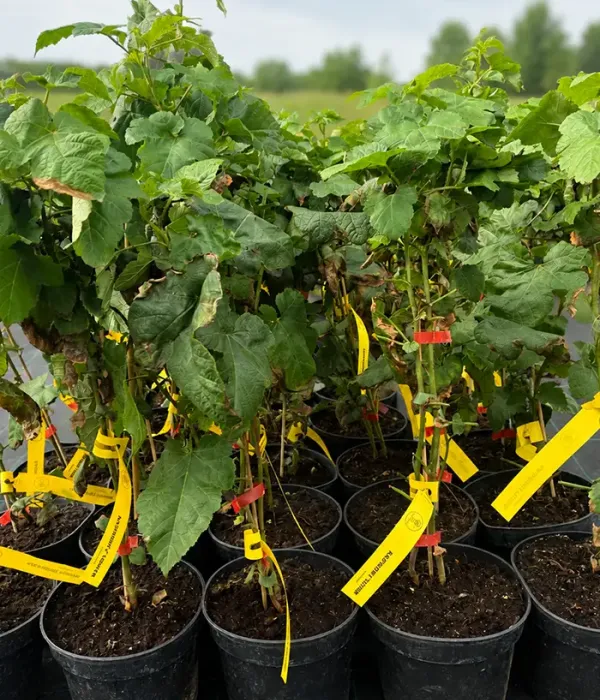
Dwarf cultivars have a shallow root system and quickly exhaust the supply of water and nutrients in a pot. Choose a container with enough volume and with drainage holes, and a free-draining, humus-rich growing medium. Raspberries do not tolerate waterlogged roots, so good drainage matters just as much as regular watering during cropping.
With cultivars of average hardiness it is safer to move containers into a cool but frost-free room for the winter, or at least to wrap and protect the root ball – in a pot the roots are exposed to frost from every side, not only from above as they are in open ground.
Please note: cultivars under plant breeders' rights
All four cultivars described here are protected by plant breeders' rights (PBR). This means that propagating them vegetatively, reselling them or passing plants on without a licence is prohibited. For the home grower this is no obstacle – growing the plants and eating the crop are of course unrestricted – but plants must be bought from licensed sources.
Pruning is simpler with these cultivars than with classic raspberries. With the summer-bearing ones – 'Ruby Beauty®', 'Groovy®' and 'Raspberry Tower' – the spent canes are cut down to ground level after picking or at the end of winter, and the young canes are left for the following crop. With the double-cropping 'Selena' it depends on whether you want one strong summer crop or two successive ones.
What all four cultivars have in common is that they need no trellis and no tying in. That is the biggest change of all, because until recently a support structure was a practically unavoidable part of any raspberry planting.
|
Raspberries for pots and for plantations
Dwarf, thornless and tree-like raspberry cultivars are available in our range, each with precise details on growth, ripening and winter hardiness. Choose the cultivar that fits exactly where you want it.
Browse raspberry cultivars
|
Join us on Facebook
Share your growing experience, ask about cultivars and show off your harvest on our Facebook page full of keen fruit growers, talk to specialists and get access to new articles first.
Visit our page
|