








Cart

Grapevine ALEŠENKIN

Grapevine ALEŠENKIN
New
Grapevine ALEŠENKIN
Specifications
Height at sale60cm
Pot3l
Ripening timeJuly/August
The standard delivery time is 2-5 working days.(except for goods "On request")
We send goods on Monday, Tuesday, Wednesday, by agreement also Thursday or Friday.
Price
24.90€
Ex Tax: 20.24€
  • Stock: In Stock
  • Model: Vitis

Table Grape 'Aleshenkin'

A time-tested, super-early white table grape featuring massive clusters, high frost tolerance, and a harmonious sweet flavor.


'Aleshenkin' (Russian: Алешенькин, also known as 'Alesha', 'Aleshenka', 'No. 328', or the improved clone 'Aleshenkin's Gift') is a historically significant, super-early white table grape (Vitis vinifera). It was bred in 1956 by Academician Pyotr Yefimovich Tsekhmistrenko at the Volgograd Experimental Station by crossing 'Madeleine Angevine' with a pollen mixture of table varieties (including 'Muscat of Hamburg') and named after his beloved grandson. Later, Orenburg viticulturist Fyodor Ilyich Shatilov refined the variety through clonal selection for enhanced drought and temperature adaptation. It is a proven classic that ripens reliably even in colder and harsher climates.

Key advantages of the variety:

  • Super-early ripening: Growing period is only 100 – 118 days (active temperature sum of 2000 – 2200 °C). Ripens reliably even in climatically adverse seasons.
  • Impressive clusters: Produces large to huge clusters averaging 500 – 600 g, with top specimens reaching 1.5 to over 2 kg.
  • Partially seedless berries: Approximately one-third of the berries in a cluster are naturally seedless.
  • High frost hardiness: Well-ripened wood withstands winter frosts down to -26 °C without damage.
  • High productivity and vigor: Regular yield of 8 – 10 kg per vine (up to 25 kg with expert care). Cuttings root exceptionally well; healthy vines produce for 15 – 20 years.
  • Hermaphrodite flowers: High self-fertility, requiring no cross-pollinator.
Fruit and Harvest
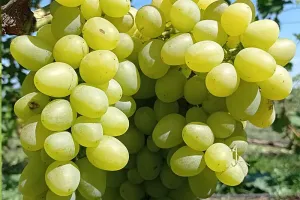
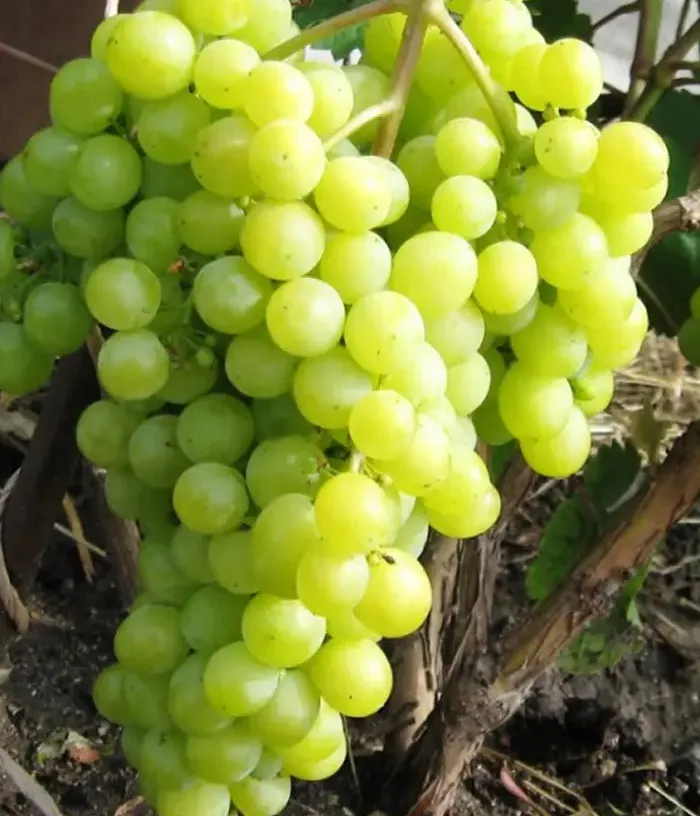
  • Appearance: Elegant conical, often branched clusters (medium-dense to loose). Berries are medium to large (4 – 6 g, approx. 20 x 18 mm), slightly oval, creamy-yellow to amber with a delicate white waxy bloom.
  • Flavor and flesh: Crisp and very juicy flesh. The flavor is harmonious and sweet with an excellent sugar-to-acid balance (sugar content 19 – 22% / °NM, acidity 3 – 5 g/l, tasting score up to 8.8 out of 10 points).
  • Harvest period: Second half of July to early / mid-August (depending on regional climate).
  • Utility: Primarily a premium table grape for fresh consumption, but also well-suited for juices, preserves, jams, and compotes.
Cultivation, Pruning and Resistance
  • Pruning and bud load: Medium pruning (5 – 6 buds) or long pruning (8 – 10 buds) is recommended. Optimal vine load is 35 – 45 buds. Shoots mature very well and typically set 2 inflorescences per shoot.
  • Crop regulation: Due to its heavy cropping tendency, strict cluster thinning is mandatory—leave 1 (maximum 2) clusters per shoot and remove excess foliage shoots to prevent vine exhaustion.
  • Site selection: Requires the warmest, sunniest locations in the garden (e.g., against south-facing walls or fences). Avoid waterlogged soils.
  • Weaknesses: Lacks complex disease resistance and is highly susceptible to fungal diseases (mildew and oidium), requiring regular preventive organic or chemical spraying. May suffer from millerandage (shot berries) in cold springs. Winter protection is advised in harsh northern zones.

Write a review

Note: HTML is not translated!
Rating
Bad Good
reCAPTCHA verification failed! Please try again.
The hazel (Corylus avellana) is a popular tree or shrub in the common garden. It is one of the low-yielding species, as the main reason for growing ..
Price
15.50€
Ex Tax:12.60€
Add to Cart