

















Domestic Plum (Prunus domestica): Origin, Botany & Anatomy
The Domestic Plum: From Caucasian Roots to the Microscopic Miracle of its Skin
When we bite into the juicy, sweet, and slightly tart flesh of a plum, we rarely think about the complex botanical and historical story hidden beneath its deep blue skin. The domestic plum (Prunus domestica L.) is an evolutionary triumph that has accompanied humanity for millennia. Interestingly, it is a relatively "young" species, cultivated in Europe for approximately 2,000 years.
“The origin of this species is located in the Caucasus Mountains near the Caspian Sea. The domestic plum is a unique hexaploid organism that likely arose through the natural hybridization of diploid cherry plum and tetraploid sloe.”
This article takes you on a deep professional excursion into the world of Prunus domestica – from its genetic roots to the microscopic structure of its fruits.
Taxonomy and Genetics: A Complex Pedigree
Botanically, the domestic plum belongs to the Rosaceae family, the Amygdaloideae subfamily, and the Prunus genus. It is classified under the subgenus Prunophora and section Euprunus, often referred to as "true plums".
Genetic Uniqueness
The scientific community assumes that Prunus domestica originated from natural hybridization between diploid cherry plum (Prunus cerasifera) and tetraploid sloe (Prunus spinosa). This fusion created a hexaploid species (6n) that combines the resilience of the sloe with the sweetness of the cherry plum.
Tree Characteristics and Environmental Needs
The domestic plum tree is a deciduous woody plant that reaches a height of 6 to 15 meters in adulthood. It features an upright habit and thornless branches. The bark of the trunk is matte brown, while young twigs have a reddish-brown tint.
- Chilling Requirements: Requires more than 800 hours of winter chill (below 7.2 °C) to properly break dormancy in spring.
- Frost Hardiness: Dormant flower buds can tolerate extremes between -15 °C and -35 °C, but open flowers die at temperatures below -2.2 °C.
- Soil: Thrives in deep sandy-loam, well-drained soils with a pH of 5.5 to 6.5.
Fruit Anatomy: A Microscopic Wonder
The fruit is a drupe and is classified as a non-climacteric fruit. This means that after harvesting, the fruits do not continue to ripen or increase their sugar content.
Structure of the Plum Fruit
| Fruit Part | Description |
|---|---|
| Exocarp (Skin) | Epidermis covered with a cuticle and a characteristic waxy bloom. |
| Mesocarp (Flesh) | Makes up 93 – 96% of the fruit. Succulent tissue containing primary nutrients. |
| Endocarp (Stone) | Hard layer of sclereids protecting the seed. |
The Secret of the Waxy Bloom
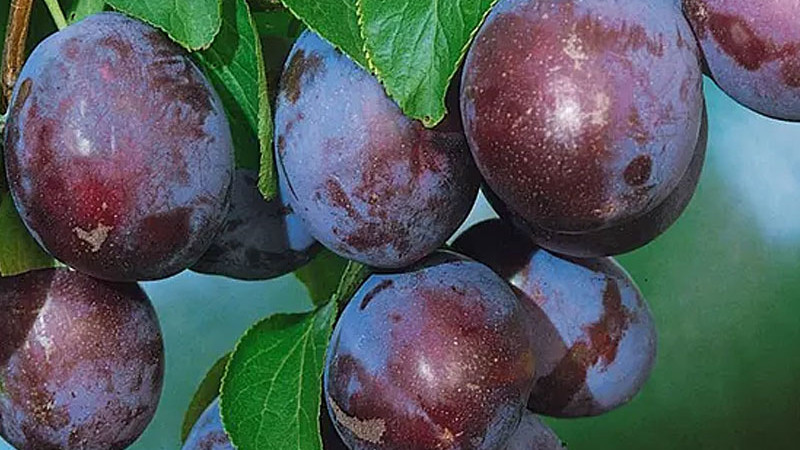
The surface of the plum is covered with an epicuticular wax layer (bloom) consisting of dense crystalline wax microgranules. This coating serves a critical protective function: it moderates gas exchange and protects the fruit from water loss, UV radiation, and pests.
Conclusion
The domestic plum (Prunus domestica) is a botanical curiosity whose hexaploid genome combines the best of its ancestors. From its deep roots in the Caucasus to the microscopic crystals protecting its fruit, the plum remains a masterpiece of nature and the queen of temperate orchards.
Grow the Queen of Orchards
Explore our high-quality plum variety selection ➤
Want to learn more about fruit growing?
Join our community and get tips from experts.
Follow us on Facebook ➤