

















Analysis of Latvian cherries: Detailed profile of the Paula, Aija and Indra varieties | Blog
Analysis of Latvian Cherry Varieties: A Detailed Profile of Paula, Aija, and Indra
In the context of adapting fruit growing to changing climatic conditions and the growing interest in varieties with high natural resistance, breeding programs from regions with challenging growing conditions are coming to the forefront. The Latvian Institute of Horticulture in Dobele is one such institution where, under the leadership of Dr. Silvija Ruisa, cherry varieties have been developed that combine excellent frost hardiness with unique quality characteristics.
"Breeding in the harsher conditions of the Baltics yields varieties with a high degree of adaptability, which are valuable genetic material for our gardens as well."
In this article, we provide a detailed pomological analysis of three such varieties: the yellow 'Paula', the high-yielding 'Aija', and the nutritionally interesting dark 'Indra'.
1. Paula – A Detailed Pomological Profile
'Paula' is a Latvian heart-type cherry variety characterized by attractive yellow fruits and a very pleasant, sweet taste.
Variety Profile: 'Paula'
- Origin: Latvia (Dobele), open pollination of the ‘Krupnoplodnaja’ variety.
- Growth: Medium vigor, with a well-formable pyramidal crown.
- Fruit: Medium to large, heart-shaped, yellow in color. The flesh is firm and creamy.
- Taste: Sweet, mild, with a high sugar content (up to 16.5 °Brix).
- Hardiness: Good frost hardiness of wood and flower buds; good disease resistance.
- Ripening Time: Mid-early (late June / early July).
Agronomic Evaluation
'Paula' is an interesting addition to the range of yellow-fruited cherries. Its main advantage is its excellent sweet taste with low acidity, making it ideal for fresh consumption as a dessert fruit. Thanks to its high sugar content, it is also suitable for processing into compotes or juices without the need for additional sweetening.
Growing Recommendations and Limitations
The variety is cross-pollinating, so to ensure a harvest, it is necessary to plant another mid-early flowering cherry variety nearby. Its biggest weakness is a slight susceptibility to fruit cracking in rainy weather, which is typical for many light and yellow varieties. Therefore, planting in an airy location where the fruit can dry quickly after rain is recommended.
2. Aija – A Detailed Pomological Profile
'Aija' is a Latvian variety valued for its high and regular yield, vitality, and excellent fruit cracking resistance.
Variety Profile: 'Aija'
- Origin: Latvia (Dobele), from the breeding material of P. Upītis.
- Growth: Vigorous, forms a more robust tree with a broad pyramidal crown.
- Fruit: Medium-sized (approx. 4 g), round. The skin is yellow, covered with a light red blush. The flesh is soft and juicy.
- Taste: Distinctly sweet and pleasant.
- Hardiness: Good frost hardiness, good resistance to fungal diseases (especially leaf spot). The fruit is highly resistant to cracking.
- Ripening Time: Mid-early (first half of July).
Agronomic Evaluation
The main asset of the 'Aija' variety is its reliability. The high yield and exceptional resistance of the fruit to cracking make it an ideal variety for growers who want a secure harvest even in variable summer conditions. Although the fruits are smaller and the flesh softer, their distinct sweetness makes them excellent for fresh eating.
Growing Recommendations and Limitations
The tree's strong growth requires sufficient space. Although not explicitly stated, planting with another simultaneously flowering variety is recommended to maximize its high yield potential.
3. Indra – A Detailed Pomological Profile
'Indra' is a Latvian variety that is interesting for its dark fruit color, high content of bioactive compounds, and very good frost hardiness.
Variety Profile: 'Indra'
- Origin: Latvia (Dobele), a selection from the material of P. Upītis.
- Growth: Vigorous, but with a compact and dense pyramidal crown (max. 3.5–4 m).
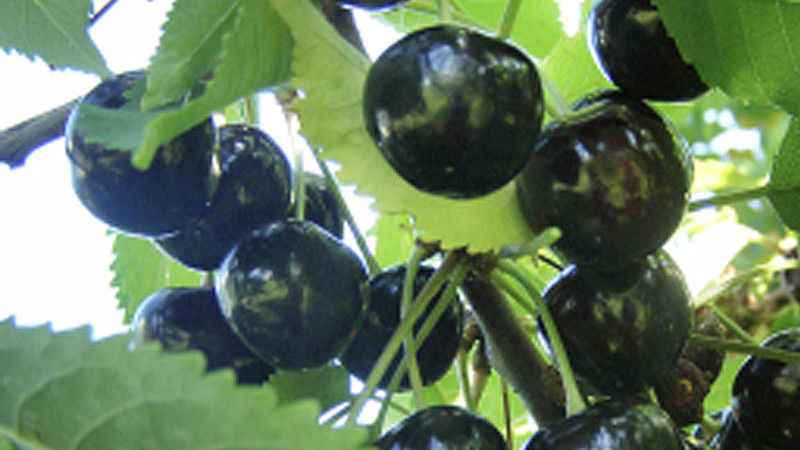
- Fruit: Smaller (3.5–4 g), dark red, almost black at full maturity. The flesh is soft, juicy, and dark red.
- Taste: Good, dessert quality, sweet (up to 17.2 °Brix).
- Nutritional Value: Has a high content of antioxidants (anthocyanins 54.4 mg/100g and phenols 417 mg/100g).
- Hardiness: Very good frost hardiness. It is used as a donor for frost hardiness in further breeding.
- Ripening Time: Mid-early (late June / early July).
Agronomic Evaluation
'Indra' is a variety for enthusiasts and growers looking for fruit with added value. Its greatest contribution is not the size of the fruit, but its high content of bioactive compounds, which is significantly higher than in common light-colored varieties. Its compact and dense growth also makes it a very ornamental tree during flowering.
Growing Recommendations and Limitations
It is cross-pollinating and requires a pollinator for fruit set. It has medium disease resistance, so choosing an airy site that reduces infection pressure is advisable.
Summary Comparison Table
Comparison of Latvian Varieties
| Characteristic | Paula | Aija | Indra |
|---|---|---|---|
| Main Advantage | Sweet taste, yellow color | High yield, crack resistance | Antioxidant content, dark color |
| Pollination | Cross-pollinating | Cross-pollinating (recommended) | Cross-pollinating |
| Fruit Color | Yellow | Light Red | Dark to Black |
Bring a Piece of the Baltics to Your Garden
These varieties prove that even in colder regions, it is possible to grow fruit of exceptional quality. Their story of resilience and unique taste can continue in your garden. Discover our exclusive Latvian varieties and find the right one for your garden.
Which of these Latvian varieties has caught your interest the most? Let us know in the comments!
Related Products


