

















Pomegranate (Punica granatum): Fruit of the gods and its benefits (Part 1)
Pomegranate (Punica granatum): The Fruit of the Gods and Its Secrets
The genus Punica was traditionally placed in its own family, Punicaceae, which included only two species. However, modern phylogenetic systems classify it into the broader family of Lythraceae (the Loosestrife family).
The Pomegranate (Punica granatum) is an ancient cultivated crop whose significance extends beyond agriculture, delving deep into the mythology, religion, and art of many civilizations. Often referred to as the "fruit of paradise" or "fruit of the gods," it is prized for its refreshing fruit, high nutritional value, and remarkable health benefits, which are now the subject of intensive scientific research.
Origin and History: The Fruit That Shaped Civilizations
The pomegranate, known by local names such as anar (Hindi), dalim (Bengali), shiliu (Chinese), or pomme grenade (French), is a deciduous or partially evergreen shrub or small tree native to the region from Iran to the northern Himalayas.
Ancient Roots
The pomegranate is among the oldest domesticated fruit species. Its origin is traced to Persia (modern-day Iran) and surrounding regions. From there, it spread throughout the Mediterranean, to Asia, Africa, and Europe.
References to it are found in many ancient texts, including the Bible, the Quran, and the Babylonian Talmud, where it symbolized fertility, abundance, and eternal life.
- The characteristic shape of the calyx at the top of the fruit is said to have inspired the design of King Solomon's crown and, later, those of other European monarchs.
- Thanks to its resilience and adaptability, it has become an integral part of agriculture in subtropical and warm temperate regions worldwide.
Botanical Characteristics of the Pomegranate
The Tree
The pomegranate tree grows to a height of 5 to 10 meters. It is a long-lived, often multi-stemmed shrub or small tree with a dense, spreading crown. The branches are often thorny, and the bark is smooth and dark gray. Depending on the climatic conditions, it can be deciduous (in colder regions with distinct winters) or evergreen (in subtropical regions).
Leaves
The leaves are simple, glossy, oblong, and 2–10 cm long. They are arranged oppositely or in clusters on short branchlets.
Flowers
The flowers are large (3–6 cm in diameter), funnel-shaped, and visually very attractive.
- They have 5–8 crinkled petals of a vibrant orange-red color.
- They grow singly or in small clusters at the ends of branches.
- The flowers are hermaphroditic (bisexual).
The pomegranate produces three morphologically distinct types of these bisexual flowers:
- Bell-shaped flowers: Functionally male. Although botanically bisexual, their female organs (pistil) are rudimentary and non-functional. They serve exclusively for pollen production and naturally fall off after blooming.
- Intermediate flowers: These have partially developed female organs. Fruit rarely forms from them, and if it does, it is small and usually drops prematurely.
- Vase-shaped flowers: Hermaphroditic (fertile) flowers. They have fully developed and functional male and female organs. High-quality, full-sized fruits develop exclusively from this type.
Why this strategy?
Creating a large fruit full of seeds and juice is extremely energy-intensive for the plant. By producing a large number of sterile flowers, the plant ensures enough pollen for the successful pollination of its fertile flowers without having to invest energy into developing fruit from every single bloom.
Pollination: Most varieties are self-pollinating, but cross-pollination with another variety often leads to a higher fruit set and better quality. Pollination is carried out by insects, especially bees.
The Fruit (Balausta)
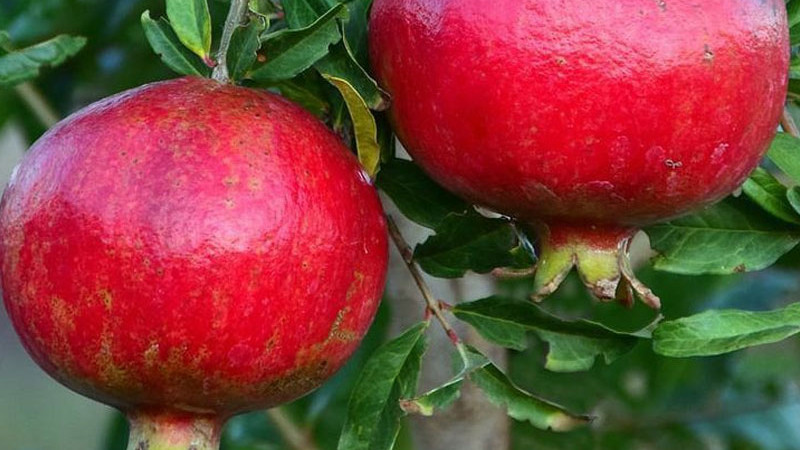
From a botanical perspective, the fruit is a special type of berry called a balausta.
- The fruit is spherical, 6–12 cm in diameter, and weighs around 200 g.
- At the top of the fruit is a distinctive "crown"—the remnant of the calyx.
- The rind (pericarp) is thick, leathery, and hard, with a color ranging from yellow to orange to deep red.
- The interior is divided by white, spongy, inedible membranes into several chambers.
- These chambers contain hundreds (around 600 on average) of seeds, each enclosed in a juicy, translucent seed coat (sarcotesta) of red to pink color.
- These seed coats, known as arils, are the edible part of the fruit.
Ecology and Growing Requirements
The pomegranate is adapted to conditions with cool winters and hot, dry summers. It is drought-tolerant but requires regular irrigation for high-quality yields and to prevent fruit cracking.
Key Requirements:
- Temperatures: Sensitive to severe frosts (damage most often occurs at temperatures below -11 °C / 12 °F).
- Soil: Prefers deep, well-drained, loamy soils with a slightly acidic to neutral reaction (pH 5.5–7.2), but it is also tolerant of poorer and calcareous soils.
- Light: Requires full sun for a plentiful harvest and proper fruit ripening.
Would you like to try growing this Mediterranean treasure? You can find high-quality and resilient pomegranate seedlings in our e-shop.
Nutritional Profile and Medicinal Use
The pomegranate is a very nutritionally valuable fruit. It is a good source of fiber, vitamin K, vitamin E, and minerals, especially potassium.
Polyphenolic Compounds
Unlike many other fruits, it is a relatively poor source of vitamin C. Its greatest significance lies in its exceptionally high content of bioactive polyphenolic compounds:
- Hydrolyzable tannins (ellagitannins): Especially punicalagin, which is responsible for most of the antioxidant capacity of the juice. It is found primarily in the peel.
- Anthocyanins: Pigments responsible for the red color of the arils (e.g., cyanidin, delphinidin), which also have strong antioxidant effects.
- Phenolic acids: Ellagic acid and gallic acid.
These compounds give the pomegranate its strong antioxidant, anti-inflammatory, and antimicrobial properties.
Uses
Culinary:
- Arils are consumed fresh or pressed into juice.
- The juice is used to make syrup (grenadine).
- In Indian and Middle Eastern cuisine, dried seeds with arils (known as anardana) are used as a sour and fruity spice.
Medicinal and Health Benefits:
Scientific studies confirm many traditional medicinal uses. Regular consumption of pomegranate is associated with:
- Cardiovascular health: Lowering blood pressure and improving blood flow.
- Anti-inflammatory effects: May help with conditions like arthritis.
- Potential anti-cancer effects: Research suggests that extracts may slow the growth of cancer cells.
- Anti-diabetic effects: Helps regulate blood sugar levels.
Other Uses:
- The tough peel and roots, rich in tannins, were historically used for tanning leather and as a natural dye.
- Ornamental and ecological: The pomegranate is prized as an ornamental plant and is important for soil reclamation in arid areas.
Propagation and Management
Propagation
- Generative (by seeds): Possible, but offspring do not retain the characteristics of the parent variety.
- Vegetative: To preserve the traits of a specific variety, hardwood cuttings are most commonly used, as they root relatively easily. Grafting is also used.
Orchard Management
Regular pruning is key to maintaining the shape of the crown, promoting light penetration, and removing diseased or dead branches.
Main Problems:
- Fruit cracking: Caused by uneven irrigation or boron deficiency.
- Pests: For example, the pomegranate butterfly (Deudorix isocrates).
Pomological Classification and Varieties
Pomegranate varieties are classified according to several criteria, such as the color of the peel and arils, seed hardness (hard-seeded vs. soft-seeded), taste (sweet, sweet-sour, sour), and ripening time.
Selected Well-Known Varieties:
- 'Ganesh': A popular Indian variety with large fruits, pink arils, and soft seeds.
- 'Mridula': A variety with dark red arils, soft seeds, and high juice content.
- 'Wonderful': The most widespread commercial variety in the USA, known for its large, deep-red fruits and sweet-sour taste.
- 'Ruby': A variety valued for its high yield and quality fruits.
Conclusion: Why the Pomegranate is Still Important
The pomegranate is a plant that combines millennia of history, deep symbolism, and modern scientific interest. Its unique taste, aesthetic value, and above all, its extraordinary health potential, derived from a unique cocktail of polyphenols, rank it among the world's most valuable fruit species.
Although its cultivation and processing present certain challenges, its benefits far outweigh these obstacles. The pomegranate thus remains a promise for a healthier and tastier future.
Did you enjoy this overview of the pomegranate? Share your growing experiences in the comments!
Related Products


