


























Blackberries Natchez and Ouachita – Thornless Arkansas Cultivars
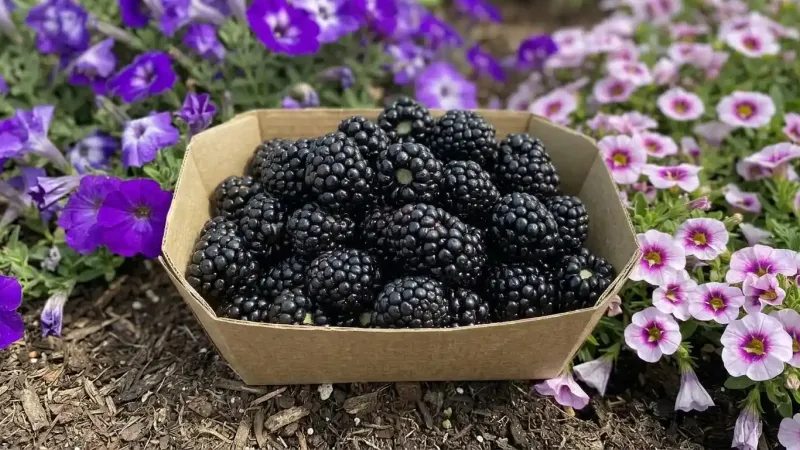
Blackberries ‘Natchez’ and ‘Ouachita’
Two thornless Arkansas cultivars combining large firm fruit, erect growth and reliable yields
The breeding programme of the University of Arkansas at Clarksville is one of the most influential blackberry breeding centres in the world. It produced the cultivars that first brought together three traits which had previously been hard to combine in a single plant: complete thornlessness, an erect habit, and fruit firm enough to survive picking, transport and several days in the refrigerator.
‘Natchez’ (original designation Ark. 2241) and ‘Ouachita’ (Ark. 1905) are two of them. They are not really competitors but rather a complementary pair in the garden: ‘Natchez’ opens the season with large, long fruit, while ‘Ouachita’ follows a week later with slightly sweeter berries and growth that manages without any trellis.
|
8–9 g
berry weight of ‘Natchez’
|
9.9%
soluble solids of ‘Ouachita’
|
2.3–3.2 kg
yield per plant
|
35–40 days
length of the harvest window
|
← Swipe the table sideways →
Origin and breeding
Both cultivars were created by hand pollination at Clarksville, Arkansas, and both belong to the group of predominantly eastern North American blackberries derived from Rubus allegheniensis (possibly with introgression of R. argutus). Their thornlessness genes come from the British cultivar ‘Merton Thornless’, which in turn derives them from R. ulmifolius.
Plant, growth and pollination
Both cultivars are vigorous and establish quickly after planting – in the case of ‘Ouachita’ even faster than most other thornless cultivars. The difference between them lies in cane stiffness.
The canes of ‘Ouachita’ – both primocanes and floricanes – grow erect and are self-supporting, so the plant needs no trellis. ‘Natchez’ has an erect to semi-erect habit and, although it can be grown freestanding, a wire trellis is recommended: under a heavy crop or in a windy site the canes tend to lodge.
In both cultivars the flowers are white, perfect and highly fertile. ‘Natchez’ blooms on average 2 to 4 days earlier than ‘Ouachita’, which in turn blooms 0 to 2 days earlier than ‘Navaho’. Both are self-fertile, so no second cultivar is needed as a pollinator to obtain a crop.
Self-fertility in practice
A self-fertile cultivar sets a full crop even when planted on its own. In small gardens this means you can choose a single cultivar purely by harvest date without worrying about pollination partners. Planting both simply extends the picking season – ‘Natchez’ starts roughly a week before ‘Ouachita’.
The fruit
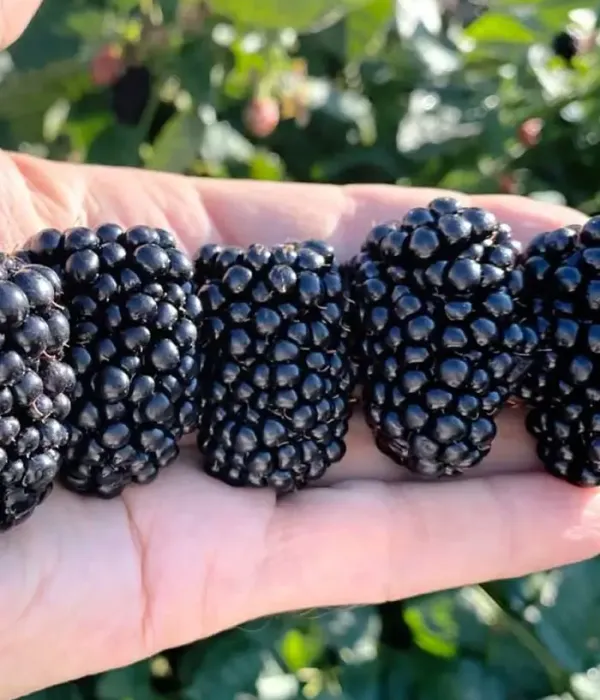
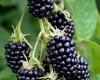
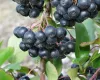
The berries of ‘Natchez’ are large, long and cylindrical, averaging 8–9 g. ‘Ouachita’ produces round-oblong to conical fruit averaging 6.0 g, which is 1.0 to 1.5 g more than its seed parent ‘Navaho’. Importantly, both cultivars maintain fruit size very well throughout the picking season, so the last berries are not markedly smaller than the first.
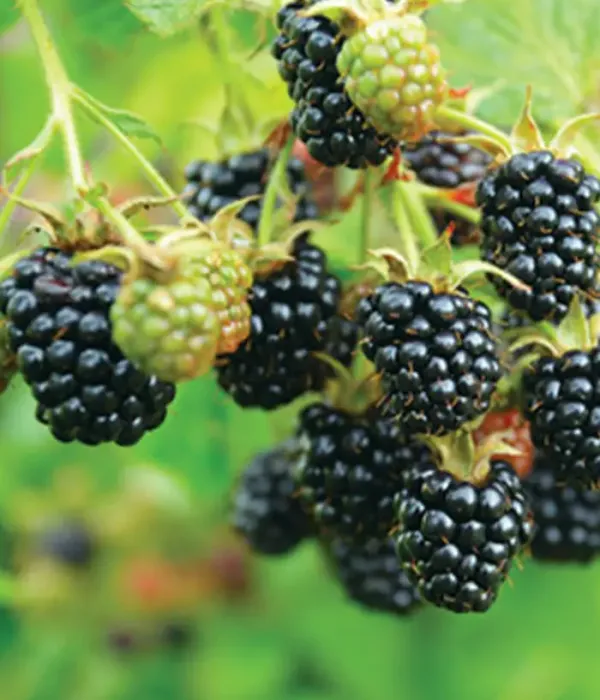
The colour in both cases is a bright, glossy black. At full ripeness the fruit is very firm: ‘Natchez’ is comparable to ‘Ouachita’, ‘Apache’ and ‘Navaho’, while ‘Ouachita’ itself is rated firmer than ‘Shawnee’ and ‘Choctaw’ and almost as firm as ‘Navaho’.
Flavour in both is good, sweet and mildly subacid with a pronounced blackberry aroma. Soluble solids average 9.5% in ‘Natchez’ and 9.9% in ‘Ouachita’, with ‘Ouachita’ reaching up to 12% in favourable seasons. Average dry seed weight is 4.2 mg in ‘Natchez’ and 4.5 mg in ‘Ouachita’.
Value scales: berry weight and sugar content
Average berry weight – scale 0–10 g
| ‘Natchez’ | 8–9 g |
| ‘Ouachita’ | 6.0 g |
Soluble solids – scale 0–12%
| ‘Ouachita’ | 9.9% |
| ‘Natchez’ | 9.5% |
← Swipe sideways →
Berry weight is plotted against a 0–10 g scale and soluble solids against a 0–12% scale, the latter corresponding to the maximum recorded in ‘Ouachita’. All figures are averages from trial plantings in Arkansas.
Ripening and yield
‘Natchez’ is an early cultivar. It begins ripening seven days before ‘Ouachita’; in Arkansas the average date of first harvest is 3 June and picking lasts 35–40 days, roughly until 11 July. ‘Ouachita’ is a mid-season cultivar: it starts seven days ahead of ‘Navaho’, on average on 12 June in central Arkansas, with a picking period of about 35 days, roughly until 17 July. In Central European conditions the dates shift according to site and the course of spring, but the interval between the two cultivars remains.
Yields are high and consistent in both, ranging from 2.3 to 3.2 kg per plant. For ‘Ouachita’ this is significantly more than its seed parent ‘Navaho’ and comparable to the highly productive ‘Apache’.
Postharvest storage of fresh fruit is excellent in ‘Ouachita’, comparable to ‘Navaho’ and better than in ‘Shawnee’ and ‘Choctaw’. ‘Natchez’ matches ‘Navaho’, ‘Apache’ and ‘Ouachita’ in this respect.
Cultivars at a glance
| Trait | ‘Natchez’ | ‘Ouachita’ |
|---|---|---|
| Year of the cross | 1998 | 1990 |
| Parentage | Ark. 2005 × Ark. 1857 | ‘Navaho’ × A-1506 |
| Habit | erect to semi-erect, trellis recommended | erect, self-supporting, no trellis needed |
| Thorns | genetically thornless | genetically thornless |
| Pollination | self-fertile | self-fertile |
| Berry weight | 8–9 g | 6.0 g |
| Fruit shape | long, cylindrical | round-oblong to conical |
| Soluble solids | 9.5% | 9.9% (max. 12%) |
| Dry seed weight | 4.2 mg | 4.5 mg |
| First harvest (Arkansas) | 3 June | 12 June |
| Harvest length | 35–40 days | about 35 days |
| Yield per plant | 2.3–3.2 kg | 2.3–3.2 kg |
| Cold hardiness | to −14 °C | to −17 °C |
| Propagation | root cuttings – very readily | root cuttings and softwood cuttings |
← Swipe the table sideways →
Disease resistance and hardiness
Plant health is among the strongest points of both cultivars. In trial plantings they appeared immune to orange rust (Gymnoconia nitens) and to double blossom, also known as rosette (Cercosporella rubi). Against anthracnose (Elsinoe veneta) they show moderate resistance or tolerance – in high-pressure seasons protection cannot be dispensed with entirely.
Cold hardiness is the weaker side. ‘Natchez’ is hardy to −14 °C and ‘Ouachita’ to −17 °C. What matters is the temperature the floricanes are exposed to during winter – frost damage to buds only becomes visible as a reduced crop the following summer.
| Cold hardiness of ‘Ouachita’ | −17 °C |
| −20 °C (hardier) | −8 °C (more tender) |
| Cold hardiness of ‘Natchez’ | −14 °C |
| −20 °C (hardier) | −8 °C (more tender) |
← Swipe sideways →
The scale runs from −20 °C to −8 °C. The green end marks greater cold hardiness, the orange end lower hardiness.
A note for colder sites
Where winter minima regularly fall below these thresholds, both cultivars will suffer without protection. A sheltered position against a wall or out of the wind, mounding the base of the plant for winter, or laying the canes down and covering them all help. In the coldest regions a hardier cultivar may simply be the better choice.
Propagation
Both cultivars propagate very well from root cuttings – they produce adventitious shoots from the roots far more readily than ‘Navaho’, the seed parent of ‘Ouachita’. ‘Ouachita’ additionally roots well from softwood cuttings.
A willingness to sucker cuts both ways: it makes propagation easy, but it also means the planting will gradually spread beyond its allotted space unless unwanted shoots are removed regularly.
Legal note
Both cultivars are protected by plant breeders’ rights (PBR). Propagating them for sale or otherwise distributing planting material without a licence is not permitted.
Which one to choose
You want the earliest crop and the biggest berries – choose ‘Natchez’. It opens the season about a week earlier and its 8–9 g fruit is among the largest of the thornless cultivars.
You would rather not build a trellis – choose ‘Ouachita’. Its canes are self-supporting, so it manages without wires, and the fruit is slightly higher in sugars.
Your site has hard winters – both cultivars will need winter protection. Without it the risk of floricane damage and crop loss is high.
If you have room for both, you gain a continuous harvest from the very start of the season into midsummer – from plants that carry no thorns, need no pollinator, and yield fruit that holds its shape in the fridge for days.
|
Thornless blackberries for your garden Proven thornless cultivars with large, firm, self-fertile fruit and a long picking window. Pick by ripening date and enjoy blackberries you can harvest without a scratch – berries that survive the trip home. Visit the shop |
Join our growers Share your growing experience, ask about cultivars and show off your harvest on our Facebook page full of enthusiastic fruit growers, talk to specialists and be the first to read new articles. Follow us |
Related Products