We have added ten new varieties of the common fig (Ficus carica) to our range. They include French classics, the modern American 'Tena', the Croatian 'Dalmatie' and the old 'Brunswick', which became famous in England. What they share is that they can be grown in a central European climate, in the ground or in a pot on a terrace.
Below you will find a short profile of each variety, a clear comparison and tips on which one to choose for your garden.
10 new varieties |
8 varieties with two crops |
−17 °C highest stated hardiness |
180 g heaviest summer figs ('Longue d'Août') |
What all the varieties have in common
Self-fertility. All ten varieties are self-fertile (parthenocarpic): the fruit develops without a pollinator and without a fig wasp, so a single tree is enough for a crop.
One or two crops. Eight varieties bear twice a year. The first, summer crop (breba) ripens on last year's wood, the second, main autumn crop on new shoots. 'Ronde de Bordeaux' and 'Violette de Solliès' bear only once, on new shoots.
Planting and winter protection. For planting in the ground we recommend strong trees that are 2 to 3 years old. For most varieties, protect the trunk and crown with horticultural fleece in colder locations until the trunk is 6–7 cm in diameter.
The varieties in detail
'Negronne' (Violette de Bordeaux)
France · compact growth · −17 °C
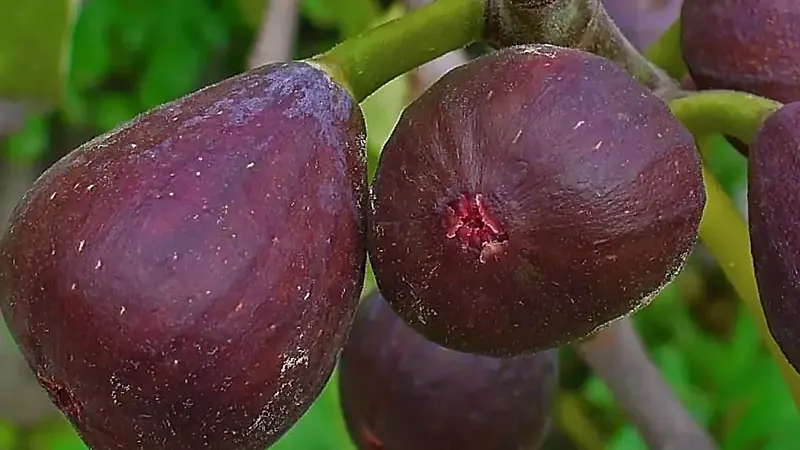
Often counted among the best-tasting figs in the world. As early as 1692 it was described by the royal gardener J. B. de la Quintinie, and it became a favourite at the court of Louis XIV. The fruit has dark skin, deep red flesh and a concentrated flavour with notes of red berries, which growers compare to a vintage red wine. The tree stays low and compact and its new wood ripens quickly, which is why it tolerates frost well. The fruit does not split in rain.
Good to know: do not leave the autumn figs to overripen on the tree, or the skin turns thick and the fruit starts to dry out. Pick them when they are soft but still juicy. To ripen its autumn crop, the tree needs full sun in September and October.
'Tena'
USA · split-resistant · −15 °C
A modern cultivar from the breeding programme of the University of California (Riverside), released in 1975. The fruit has pale green to yellow skin and mild, honey-sweet flesh. Its distinctive feature is a closed eye: during rain, neither moisture nor small insects get inside, so the flesh does not start to ferment and the fruit resists splitting. The tree grows upright to 3–4 m, is easy to keep in shape by pruning, and its cuttings root very readily. In hot weather the fruit may start to dry on the tree, which makes it suitable for drying.
Good to know: young trees need winter protection in the first years after planting in the ground.
'Brunswick'
unclear origin · large summer figs · −15 °C
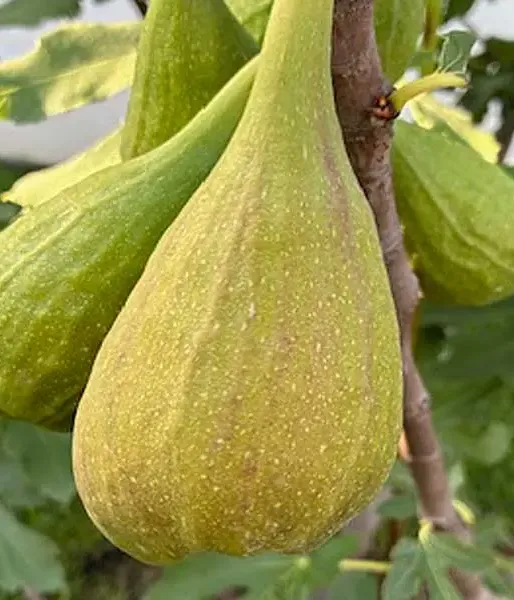
A large-fruited cultivar that spread through England in the 18th century and then across Europe because it ripens reliably even in a cooler climate. The summer (breba) figs weigh 100–120 g, are pear-shaped and have very juicy, honey-sweet flesh with delicate berry notes. The deeply lobed leaves make the tree look like an ornamental maple. It stays low and wide (2.5–3 m tall, up to 3.5 m across).
Good to know: in our conditions the summer crop is the most reliable; the autumn crop needs a long, hot summer. It is excellent for pots: after leaf fall, move it to a frost-free cellar or garage for the winter.
'Sultane'
France (Provence) · firm skin · −15 °C
A French cultivar with a long tradition, already described in the horticultural literature of the 19th century. The summer figs (60–85 g) have strawberry-pink to red flesh with a honeyed sweetness. The autumn figs are smaller but have an unusually firm skin, so they cope well with picking and transport. The tree is vigorous and spreading (3–4 m), forms a dense green screen and responds well to spring pruning.
Good to know: you can tell a fig is ripe when its neck softens, the fruit bends down on its stalk and no white milky sap runs out when you pick it.
'Ronde de Bordeaux'
France · early · −17 °C · one crop a year
One of the most reliable varieties for a central European climate. It bears only once a year (no summer crop), but the main crop starts ripening in early August, so the fruit ripens before the first frosts even in cooler locations. The small, round fruit (35–45 g) has dark purple skin with a waxy bloom and dense, jam-like flesh with notes of blackberry and currant. It is among the most frost-hardy varieties and recovers quickly after winter setbacks.
Good to know: the tree is vigorous (3.5–4 m), so give it plenty of space and thin it out with a spring pruning.
'Madeleine des Deux Saisons'
France (Anjou) · striped fruit · −15 °C
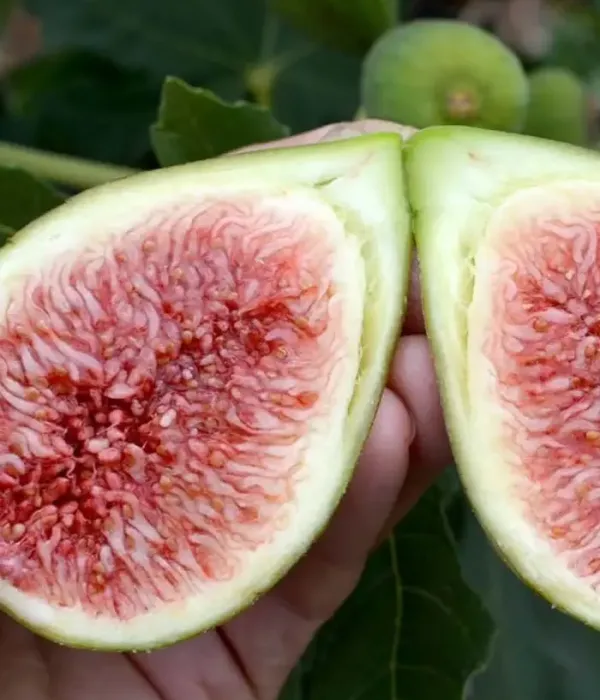
A historic cultivar that, according to tradition, was grown in the royal gardens at Versailles. The summer figs are large (100–120 g), with cream-pink skin striped golden-brown and bright red flesh with a sweet, fresh taste. They ripen from early August. The autumn crop is usually more abundant, with smaller fruit (70–80 g) and a concentrated flavour. The tree grows upright (2.5–4 m).
Good to know: to stop the tree from shooting up, pinch out the young green shoots in June. The crown branches out and the tree puts more energy into the fruit.
'Longue d'Août'
France · the “banana fig” · −17 °C
An old French cultivar with the largest summer figs in this range: the elongated fruit weighs 120–180 g and, once ripened in the sun, has a delicate banana note. The flesh is light red, juicy and honey-sweet. The fruit tolerates moisture well and neither splits nor rots even in a longer rainy spell. The main crop ripens from mid-August to September, and in warm years and southern locations until October. Mature trees withstand frost down to −17 °C.
Good to know: this vigorous, spreading tree responds well to summer pruning. If you shorten the new green growth to the fourth or fifth leaf in June, you slow down wood growth and speed up the ripening of the autumn crop.
'Dorée' (Goutte d'Or)
France · “Golden Drop” · −16 °C
One of the oldest French cultivars, first described by the pomologist Merlet in 1667. The summer crop ripens as early as early July; the fruit (85–100 g) has golden-yellow skin and very fine, exceptionally sweet flesh. A drop of thick syrup at the eye of the fruit shows that it is ripe. The autumn figs (70–80 g) are excellent for drying. The tree is compact (2–3 m) and usually starts bearing in the second to third year after planting.
Good to know: the skin is very delicate and may split when there is too much water. The fruit does not travel well and is best eaten fresh from the tree.
'Dalmatie'
Croatia (Hvar) · giant fruit · −15 °C
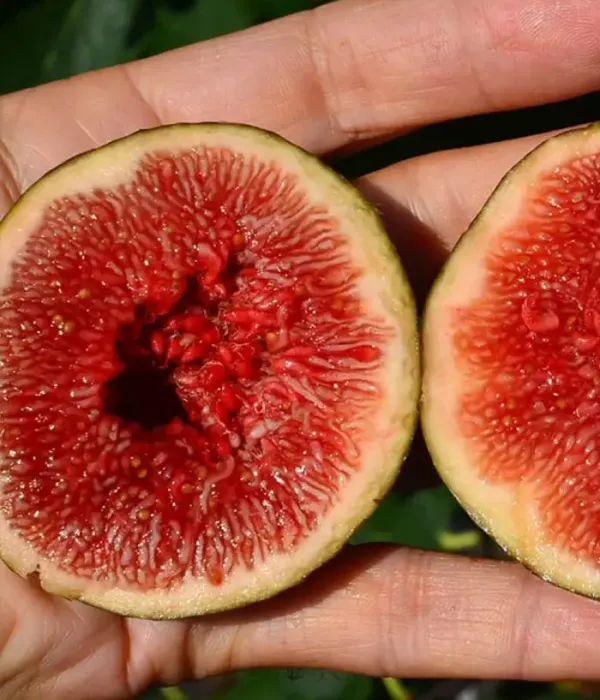
A variety from the island of Hvar with huge fruit: summer figs weigh 120–150 g and autumn figs 100–120 g. The flesh is deep red, dense and sweet, and when perfectly ripe a drop of sweet “honey” runs from the eye. Its most valuable trait is its resistance to moisture: the fruit does not split or rot when it rains before harvest. The tree is low and sparsely branched, with large, deeply lobed leaves, and suits both pots and small gardens.
Good to know: in cooler regions the summer figs drop during temperature swings. Remove them when they are the size of a pea: the autumn crop then ripens 1 to 3 weeks earlier. Snap out surplus new shoots.
'Violette de Solliès'
France (Provence) · PDO · one crop a year
A French variety protected as “Figue de Solliès” (PDO) and prized for its complex flavour. The drop-shaped fruit has dark purple to black skin with a waxy bloom and red flesh like strawberry jam. Under the PDO rules the fruit must reach at least 14 °Brix. The flavour recalls strawberry, melon and rhubarb with floral notes. It bears only once a year, in our conditions from September to October, is self-fertile and starts bearing 1 to 2 years after planting.
Good to know: it needs a sheltered, warm position and at least 8 hours of direct sun a day. In cooler regions grow it in a container, overwintered in a cool place, or under glass. Ripe fruit is very soft, so eat it fresh right after picking. Yellow spots on the leaves of young plants (a harmless fig mosaic virus) usually disappear once the plant is established and do not affect fruit quality.
Beware of mix-ups between varieties
'Tena'. For years this variety was propagated and sold by mistake under the name 'White Marseilles'. You can recognise the true 'Tena' by its leaves with five long lobes and its pinkish flesh.
'Dalmatie'. Two different types are sold under this name, one with green-purple fruit and one with purely green fruit. Our description applies to the true, green-fruited variety, which the botanist Trabut described in 1904.
Frost hardiness of the varieties
A comparison of the hardiness of mature, well-established trees, based on the data for each variety.
| 'Ronde de Bordeaux' |
−17 °C |
| 'Madeleine des Deux Saisons' |
−15 °C |
| 'Violette de Solliès' |
−15 to −17 °C (short periods) |
Scale: 0 to −20 °C. Actual hardiness depends on the site, the winter and winter protection.
← Swipe sideways →
The varieties at a glance
| Variety |
Origin |
Crops per year |
Summer crop (breba) |
Main autumn crop |
Hardiness |
Tree height |
| 'Negronne' |
France |
2 |
from early Jul, ~50 g |
mid-Aug to Oct, 35–45 g |
−17 °C |
2.5–3 m |
| 'Tena' |
USA |
2 |
Jul, ~50 g |
late Aug to Oct, 40–45 g |
−15 °C |
3–4 m |
| 'Brunswick' |
unclear |
2 |
from mid-Jul, 100–120 g |
late Aug to Sep, ~80 g |
−15 °C |
2.5–3 m |
| 'Sultane' |
France |
2 |
from late Jul, 60–85 g |
mid-Aug to Sep/Oct, 40–60 g |
−15 °C |
3–4 m |
| 'Ronde de Bordeaux' |
France |
1 |
– |
early Aug to Sep, 35–45 g |
−17 °C |
3.5–4 m |
| 'Madeleine des Deux Saisons' |
France |
2 |
from early Aug, 100–120 g |
mid-Sep to Oct, 70–80 g |
−15 °C |
2.5–4 m |
| 'Longue d'Août' |
France |
2 |
Jul, 120–180 g |
mid-Aug to Sep, 60–80 g |
−17 °C |
2.5–3 m |
| 'Dorée' |
France |
2 |
from early Jul, 85–100 g |
mid-Aug to Oct, 70–80 g |
−16 °C |
2–3 m |
| 'Dalmatie' |
Croatia |
2 |
120–150 g |
100–120 g |
−15 °C |
not stated |
| 'Violette de Solliès' |
France |
1 |
– |
Sep–Oct, diameter min. 40 mm |
−15 to −17 °C (short periods) |
not stated |
← Swipe the table sideways →
The figures apply to mature, well-established trees. A dash means the variety does not produce a summer crop. Where no date or height is given, we do not have the data.
Growing tip: how to tell a fig is ripe
Figs do not ripen after they are picked, so harvest them only when fully ripe. A ripe fruit is soft, its neck gives way, it bends down on its stalk and no white milky sap runs out. With 'Dorée' and 'Dalmatie', a drop of syrup at the eye of the fruit also shows that it is ripe.
Which variety to choose
|
For pots and small gardens: 'Negronne', 'Brunswick', 'Dorée' and 'Dalmatie' grow low and compact. |
|
For cooler locations: 'Ronde de Bordeaux' ripens from early August, 'Dorée' gives summer figs as early as early July, and 'Negronne' tolerates frost well. |
|
Needs more warmth: 'Violette de Solliès' needs a warm position and at least 8 hours of sun a day, the autumn crop of 'Brunswick' needs a long, hot summer, and the main crop of 'Dalmatie' calls for removing the summer figs in cool regions. |
← Swipe sideways →
|
New fig varieties in our shop
Choose from ten fig varieties, from early, frost-hardy ones to large-fruited varieties suited to pots. Browse the range and find the right fig for your garden or terrace.
Visit the shop
|
Follow us on Facebook
Share your growing experience, ask about varieties and exchange tips with fellow fruit growers on our Facebook page. Join the discussion with experts and be the first to read our new articles.
Open our Facebook page
|