

























Plum Varieties Guide (Part 3): Cold-Hardy and Hybrid Jewels
Plum Varieties Guide (Part 3): Cold-Hardy Hybrids and Jewels from Eastern Europe and the Baltics
Resilience Tested by Harsh Nature
Welcome to the third part of our comprehensive guide to plum varieties. While in previous parts we focused on traditional and Western cultivars, today we turn our attention to the East and North. We will introduce varieties born in the harsh climatic conditions of Russia, Belarus, Lithuania, Latvia, and Romania.
These so-called hybrid, Russian, or Siberian plums are masterpieces of breeders. They excel in extreme cold hardiness, early onset of bearing, and high resistance to diseases. Despite their robustness, however, they do not lag behind in quality – offering huge, juicy fruits with excellent tasting scores. Let's take a detailed look at six exceptional varieties that will enrich any orchard and bring a harvest even where other varieties fail.
1. Hybrid Plum 'Alyonushka' (Аленушка)
This exceptional Russian variety, created by crossing the 'Kitayanka' and 'Krasny shar' varieties, was included in the register for the Central Black Earth Region in 2001. 'Alyonushka' is a tree of smaller, very compact growth, usually not exceeding a height of 2.5 meters. Its pyramidal crown turns into a beautiful white flood of flowers in early May, making it not only a useful but also a highly decorative addition to the garden.
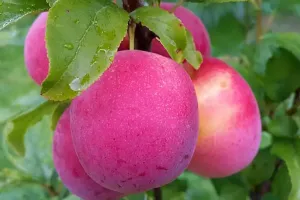
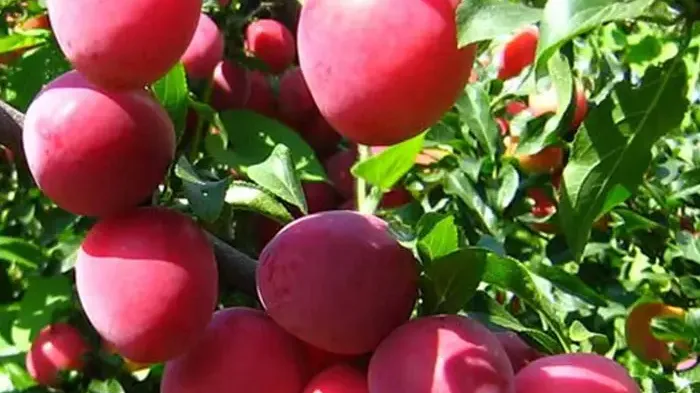
Taste and appearance of fruits: In mid-August, the tree brings a mid-early harvest of large, round fruits weighing 35 to 40 grams. Their skin is an appealing red and covered with a fine waxy bloom. Upon biting into it, you will be surprised by the orange, medium-firm, and extremely juicy flesh. The taste is pleasantly sweet and sour, which is confirmed by a high tasting score of 4.6 out of 5. The fruits are versatile – great for fresh consumption, processing, and freezing.
Cultivation and resilience: The variety comes into bearing very early, already in the third year after planting. Although its yield is rated as medium, it is very reliable and regular. Since it is a cross-pollinating variety, it requires another hybrid plum nearby. Growers will appreciate its resistance to brown rot (monilia) and shot hole disease, as well as the good cold hardiness of its flower buds. When growing, however, one should be careful of excessive rainfall, which can cause slight damage to the bark.
2. Russian Plum 'Kubanskaya Kometa' (Кубанская Комета)
'Kubanskaya Kometa' is a true legend among Russian hybrids. It was bred by crossing the Chinese plum 'Skoroplodnaya' and the myrobalan 'Pionerka' and entered the state register as early as 1987. This tree is characterized by weaker growth and forms a sparse, flat-round crown, which significantly facilitates both harvesting and maintenance.
Taste and appearance of fruits: It is an early variety that will delight you with its fruits as early as July. The fruits are large (around 30 g), elongated, slightly asymmetrical, and attract attention with their deep red color. Beneath the skin lies yellow, medium-firm, and slightly fibrous flesh. The flavor profile is excellent, sweet and sour with a medium aroma, earning the variety a tasting score of 4.6 points. The only minor drawback when eating is the pit, which is harder to separate from the flesh (clingstone).
Cultivation and resilience: This partially self-fertile variety is known for its phenomenal, regular yield, which can reach up to 100 kg from a single tree. It comes into bearing in the fifth year. It is extremely cold-hardy, highly resistant to fungal diseases, and its fruits do not crack or drop when overripe. However, the grower should remember that with such a massive fruit set, the tree tends to produce smaller fruits, so thinning is advisable in years with a heavy crop.
3. Belarusian Plum 'Soneika' (Сонейка)
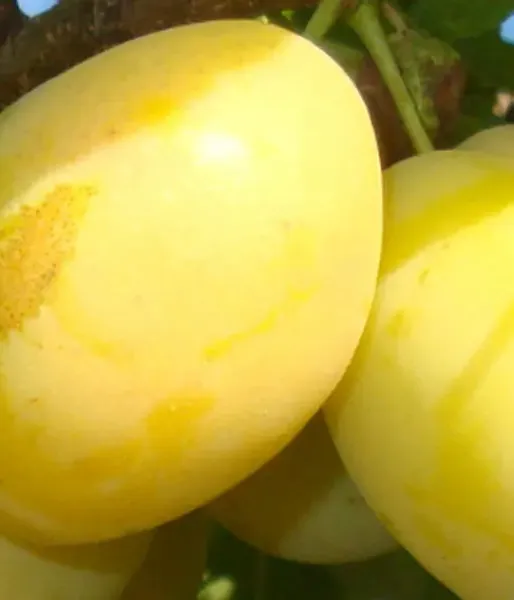
The name of this Belarusian variety translates to "Sunshine," which perfectly describes the appearance of its fruits. It was bred at the Institute for Fruit Growing by pollinating the 'Mara' variety with a mixture of pollen from diploid plums and registered in 2009. The tree grows relatively weakly, reaching a height of about 2.5 meters. Its pyramidal crown becomes spreading to weeping with age and under the weight of the crop.
Taste and appearance of fruits: 'Soneika' is a late variety that ripens at the end of August. Its fruits are truly impressive – very large, weighing 40 to 45 grams. They have a round shape and a beautiful golden-yellow color, adorned with a delicate pink blush on the sunny side. The orange-yellow flesh is firm, very juicy, and aromatic. The taste is sweet with a fine, refreshing acidity. As with many other hybrids, the pit is firmly attached to the flesh.
Cultivation and resilience: The variety is a dream for any impatient gardener, as it brings its first fruits already in the second or third year after planting. The yield is high, reaching up to 40 kg per tree. It is a cross-pollinating variety, so it requires the presence of a suitable pollinator. It excels in very high cold hardiness, excellent resistance to drought and diseases (especially shot hole disease). A great advantage is that the fruits do not drop before full ripening and tolerate transport well.
4. Lithuanian Plum 'Aleksona'
This Lithuanian jewel was bred back in 1966 and has been a proud part of Lithuania's national genetic resources since 2008. 'Aleksona' forms medium-strong trees with a spherical, medium-dense crown, reaching a height of about 3 meters in their ninth year. It is an undemanding variety that adapts well to various soil conditions.
Taste and appearance of fruits: At the end of August, the tree offers a visually and tastefully breathtaking spectacle. The fruits are elliptical and exceptionally large, commonly reaching a weight of 50 to 60 grams. The basic yellow skin is covered with an intense red to pink blush on the sunny side and protected by a bluish waxy bloom. The yellow flesh is firm, medium juicy, and offers a sweet, refreshing, and highly aromatic taste. A huge advantage for processing is that the pit separates from the flesh very easily (freestone).
Cultivation and resilience: 'Aleksona' is partially self-fertile, but cross-pollination is recommended to maximize yields. It comes into bearing in the third to fourth year and bears annually and very abundantly. It is precisely this high yield that requires the grower's attention – the tree tends to overcrop, which can lead to branch breakage without timely fruit thinning. The variety boasts good cold hardiness of both wood and flower buds and overall resistance to common diseases.
5. Latvian Plum 'Ance'
'Ance' is a modern Latvian variety that was officially registered and protected in 2018. This strongly growing tree, reaching a height of up to 3.5 meters, forms a spreading, massive, and above all, very healthy crown. To maintain abundant bearing, spring pruning is recommended, during which the ends of one-year-old shoots are shortened and vertical branches are removed, ensuring better light penetration and fruit coloration.
Taste and appearance of fruits: In the first half of August, medium-sized, elliptical fruits weighing 30 to 45 grams ripen. Their skin has a beautiful amber-yellow color, occasionally adorned with a light pinkish blush. The yellow flesh is medium-firm, very juicy, and hides a delicious, sweet taste with a distinct honey flavor at full maturity. The pit separates from the flesh very well, making it an ideal dessert variety for fresh consumption.
Cultivation and resilience: The variety is cross-pollinating and blooms mid-early. It bears regularly and abundantly, especially on two- and three-year-old wood. It is characterized by low susceptibility to shot hole disease and rust. The fruits hold well on the tree, but growers should keep in mind that at the stage of full "honey" maturity, they are softer and tolerate transport less well. For transport purposes, it is therefore better to harvest them slightly earlier.
6. Romanian Plum 'Andreea'
This list is concluded by the excellent Romanian variety 'Andreea', officially recognized in 2000. The tree has a medium to weaker, upright growth and forms a medium-dense crown. Its huge agronomic advantage is that it bears predominantly on short fruiting wood (spurs). Thanks to this compact growth and bearing character, 'Andreea' is perfectly suited for modern, more intensive plantings.
Taste and appearance of fruits: In the middle of summer, usually late July to early August, medium-sized fruits (30 – 50 g) of a spherical to slightly elongated shape ripen. Their blue-purple skin is dotted with characteristic reddish-purple spots and covered with a bloom. The yellow flesh is fiber-free, medium-firm, and offers a very pleasant, harmoniously balanced sweet and sour taste. The pit is non-adherent, meaning it separates easily from the flesh (freestone).
Cultivation and resilience: 'Andreea' is a partially self-fertile variety, but to achieve maximum yields, it is recommended to plant it with pollinators like Stanley or Anna Spath. It is characterized by high, regular bearing and excellent resistance to diseases. It is a truly versatile plum – excellent for fresh consumption, ideal for making compotes, jams, or distillates, but thanks to its flesh structure, it is especially valued for drying.
Conclusion
The third part of our guide clearly shows that breeding programs in Eastern Europe and the Baltics have brought true fruit-growing treasures to the world. Varieties like Alyonushka, Kubanskaya Kometa, or Soneika prove that even in areas with harsh winters, it is possible to grow huge, sweet, and exceptionally high-quality plums. Whether you are looking for a variety for fresh consumption, drying, or making distillates, these cold-hardy hybrids are a safe bet for any grower.
Choose the most resilient varieties for your garden
View our offer of premium plums ➤
Interested in growing cold-hardy varieties?
Join our community and discuss with experts.
Join the VIP Facebook group HERE ➤
Related Products