
































The Golden Mean: Botanical Secrets of the Duke Cherry (Prunus × gondouinii)

The Golden Mean of Fruit Growing: Botanical Secrets and Unique Characteristics of the Duke Cherry (Prunus × gondouinii)
Imagine the perfect fruit that takes the best from two different worlds. On one side stands the sweet, firm, and majestic sweet cherry, on the other the juicy, tart, and rustic sour cherry. Nature, in its ingenuity, did not wait for the laboratory crosses of modern breeders and created a bridge between these two species itself.
The result is the duke cherry, botanically known as Prunus × gondouinii. This natural hybrid represents not only a culinary delight but, above all, a botanical puzzle. How exactly did this cross arise, why can't it reproduce on its own, and by what unmistakable signs can you distinguish it from its parents in the orchard? Let's dive into the detailed botanical and morphological characteristics of this exceptional fruit species.
Taxonomy and Genetic Origin: When Nature Makes a Mistake That Tastes Good
The duke cherry belongs to the rose family (Rosaceae), subfamily Prunoideae, genus Prunus, and subgenus Cerasus (Höfer and Peil, 2014; Khadivi et al., 2019). Its scientific name is Prunus × gondouinii (Poit. & Turpin) Rehd., and from a genetic perspective, it is an extremely interesting taxon.
This species is considered a natural hybrid that originated from the fertilization of a sour cherry (Prunus cerasus L.) by unreduced gametes of a sweet cherry (Prunus avium L.) (Iezzoni et al., 1990).
However, this hybrid origin takes its toll in the form of reproductive limitations. Due to disorders during meiosis, these hybrids are often sterile (Iezzoni et al., 1990). Their seeds are usually non-viable, which means that in agricultural practice, the trees must be propagated exclusively clonally, i.e., vegetatively (Tavaud et al., 2004; Pérez-Sánchez et al., 2008; Pérez et al., 2010).
Genetics in Brief
- Sweet cherry: diploid species (2n = 2x = 16)
- Sour cherry: allotetraploid species (2n = 4x = 32)
- Duke cherry: tetraploid species with AAAF genome (2n = 4x = 32)
Tree Habit and Shoots: The Perfect Compromise
The basic rule when describing the duke cherry is the word "intermediary" (transitional). The characteristics of the tree, flowers, leaves, and fruits form an almost perfect transition between its two parents (Tavaud et al., 2004; Pérez-Sánchez et al., 2008).
While sweet cherries tend to grow very upright and sour cherries (such as local Spanish varieties) often form weeping, shrub-like crowns, duke cherries exhibit a moderately spreading crown habit (Pérez-Sánchez et al., 2008; Pérez et al., 2010).
An interesting diagnostic feature is also hidden on one-year-old dormant shoots. If we were to count the lenticels on an area of 20 mm², we would find that sweet cherries have a high number (around 10), sour cherries a low number (around 3), while duke cherries again show an intermediate value – approximately 5 lenticels per 20 mm² (Pérez et al., 2010).
Leaves: Glands, Hairs, and Shape
The leaves of duke cherries are obovate-elliptical and pointed at the apex. Their margins are crenate-serrate and are characterized by the presence of coarse glandular teeth. On the underside of the leaf, along the venation, there is a medium degree of hairiness (pubescence), which is again a trait standing halfway between the heavily pubescent leaves of sweet cherries and the completely hairless (glabrous) leaves of sour cherries (Pérez et al., 2010).
The stipules are linear with a frequent occurrence of glandular hairs. A very specific feature is also the anthocyanin coloration of the leaf glands, which is reddish in duke cherries (Pérez et al., 2010).
Flowers: A Pink Secret and Bract Shape
If you want to safely identify a duke cherry during blooming time, you must focus on details that escape the ordinary eye. Research has shown that a key differential parameter is the shape of the inner bracts at the base of the flower clusters. In duke cherries, these bracts have a sessile, semi-elliptical, and dentate central lobe, while the lateral lobes are obtuse, poorly developed, and covered with glandular hairs (Pérez et al., 2010).
Even more interesting, however, is the visual manifestation of the flower petals. While the flowers of both sweet and sour cherries remain snow-white until they drop, the petals of duke cherries acquire a delicate pinkish coloration just before wilting (Pérez et al., 2010). This phenomenon is a reliable and quick visual indicator of this hybrid in the orchard.
Fruits and Seeds: A Sweet-Tart Reward with a Deformed Pit
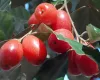
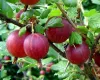
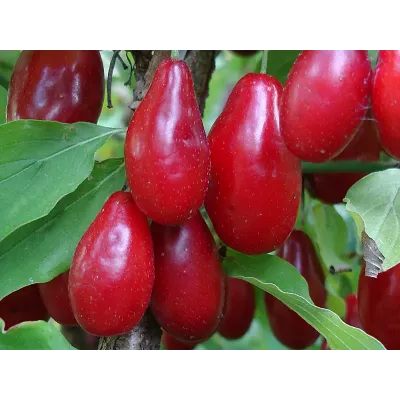
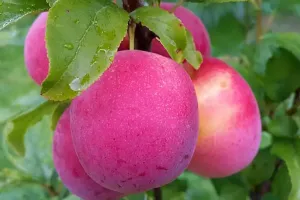
Duke cherry fruits are economically important in temperate zones, and their consumption is growing, partly due to recent attention paid to their health benefits (Iezzoni et al., 1990; Khadivi et al., 2019). In terms of shape, the fruits are usually oblate (flattened), with a relatively rounded endocarp (pit) and a straight or concave pistil point. Interestingly, small leaflets often occur at the fruit stalk (pedicel) (Pérez-Sánchez et al., 2008; Pérez et al., 2010).
The fruit quality, size, weight, and taste are again intermediate. They are sweeter and firmer than sour cherries, but more tart and softer than sweet cherries. Well-known and studied cultivars include, for example, the Spanish 'Guindo Tomatillo', 'Guindo Garrafal Negro', or 'Guindo Garrafal Rosa' (Pérez-Sánchez et al., 2008; Pérez-Sánchez et al., 2017), or historical varieties like 'Königin Hortense', 'Imperatrice Eugenie', and 'Schöne von Montreuil' (Höfer and Peil, 2014).
The greatest proof of hybrid origin, however, is found inside the fruit. The seeds of duke cherries are non-viable because they exhibit typical external deformations of crosses. Looking closely at the pit, it can be observed that the ridges on the seed coat branch towards both the chalaza and the micropyle, which is a unique feature distinguishing them from both parent species (Pérez et al., 2010).
| Botanical Trait | Sweet Cherry (P. avium) | Duke Cherry (Hybrid) | Sour Cherry (P. cerasus) |
|---|---|---|---|
| Crown habit | Upright | Moderately spreading | Weeping / Shrub |
| Lenticels (per 20 mm²) | High number (~10) | Intermediate (~5) | Low number (~3) |
| Leaf pubescence | Strong | Medium | Completely hairless |
| Flower color (before dropping) | Snow-white | Delicate pinkish | Snow-white |
| Taste and texture | Sweet and firm | Sweet-tart, medium firm | Tart and soft |
| Seeds | Viable | Non-viable (deformed) | Viable |
Conclusion
The duke cherry (Prunus × gondouinii) is a botanical unique that combines the robustness and acids of the sour cherry with the size and sugars of the sweet cherry. Although its hybrid origin has deprived it of the ability to reproduce generatively and left it dependent on human care, its morphological features – from pinkish flower petals and specific bracts to deformed pits – make it an interesting subject for botanists and breeders alike.
Preserving these traditional, often endangered cultivars in gene banks is not only a matter of saving history but also of conserving valuable genetic material that may in the future bring new, resilient, and exceptionally tasty varieties to our orchards. The duke cherry is living proof that the best things often arise exactly on the border of two different worlds.
Enrich your orchard with exceptional varieties
View our offer of fruit trees ➤
Interested in the science behind growing and crossing fruit trees?
Join our community and discuss with experts.
Join the VIP Facebook group HERE ➤