










































The Quest for the Perfect Cherry: How Science is Changing Our Favorite Fruit
The Quest for the Perfect Cherry: How Science and Modern Breeding Are Changing the Size, Taste, and Resilience of Our Favorite Fruits
Imagine the ideal cherry. It is huge, crunches pleasantly when you bite into its dark, glossy skin, and your mouth is immediately flooded with a perfect harmony of sweet and slightly tart juice. This seemingly simple culinary experience, however, is no random act of nature. It is the result of decades of tireless work by scientists, geneticists, and fruit growers.
Today's global market and demanding consumers no longer accept small, soft fruits that crack after the first summer rain. A true "quest for the perfect cherry" has begun.
How exactly are modern breeding programs and innovative growing technologies changing the DNA and physiology of the sweet cherry (Prunus avium L.)? Let's take a look behind the scenes of global and local laboratories and orchards where the fruit of the future is born.
The Anatomy of Perfection: What Do the Market and Consumer Actually Want?
In the past, the cherry was perceived as a home garden fruit with a very short shelf life. Today, it is a highly valued global commodity. For a cherry to succeed on the international market, it must meet strict parameters precisely defined by scientists.
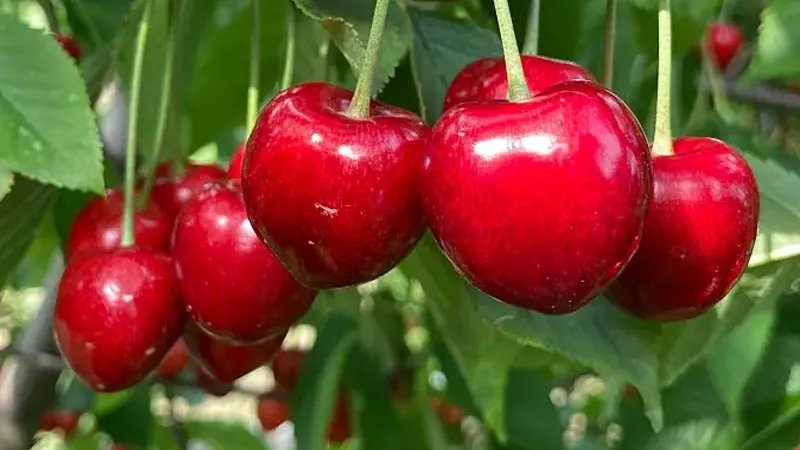
According to extensive consumer surveys and retail chain requirements, the "ideal" red sweet cherry is characterized by an optimal weight of 12 to 15 grams and a fruit diameter reaching up to 34 mm (Blando & Oomah, 2019). Current growers and retailers are looking for large-fruited varieties, with the optimal fruit width now considered to be the 30 mm mark and above (Vávra, 2024).
Taste and Color
Size isn't everything, however. Consumers prefer a dark red to mahogany skin color, high flesh firmness (more than 400 g measured by a penetrometer), and a minimum soluble solid concentration (sugars) of 18° Brix. The balance between sweetness and acidity is also crucial, with the optimal juice pH being around 3.8 (Blando & Oomah, 2019).
Interestingly, Hungarian researchers found that buyers prefer sweet cherries, but paradoxically not those with an "extremely sweet" taste. Uniformity of shape and a medium-long stem ranging from 40.1 to 45.0 mm are also important to them (Zelený et al., 2025).
Goals of Modern Breeding: More Than Just a Large Fruit
Achieving the above parameters is only half the battle. Breeders must also consider the tree itself and its ability to survive and bear fruit in changing climatic conditions. Modern breeding goals therefore focus on a comprehensive package of traits (Blando & Oomah, 2019; Zelený et al., 2025):
- Self-fertility: Traditional cherry varieties are cross-pollinating, requiring the planting of different varieties and the presence of pollinators. The development of self-fertile hybrids is a huge step towards more stable yields (Zelený et al., 2025).
- Cracking resistance: Fruit cracking caused by rain just before harvest is a fruit grower's nightmare. Breeding for flexibility and elasticity of the epidermis (skin) is an absolute priority.
- Compact growth and suitability for mechanized harvesting: To reduce labor costs, trees with smaller vigor are sought.
- Adaptability to climate change and pests: Global warming and the emergence of new invasive pests (such as the Drosophila suzukii fruit fly) force breeders to search the gene pool for alleles providing resistance to biotic and abiotic stresses (Zelený et al., 2025).
A Success Story: The Czech Breeding Program in Holovousy
An excellent example of how theoretical goals are translated into practice is the breeding program at the Research and Breeding Institute of Pomology in Holovousy (Czech Republic), which began in the early 1970s. Since then, more than 25 new sweet cherry varieties have been released (Vávra, 2024).
This program is a showcase of meticulous work: annually, about 25 parental combinations are artificially pollinated here, representing 10 to 15 thousand pollinated flowers, from which about 500 seedlings are grown in greenhouses. The emphasis is precisely on size, firmness, taste, and reliable yield potential (Vávra, 2024).
The results of this program are top modern varieties (tested in 2017–2020):
'Tamara' and 'Horka'
They were evaluated as the absolute largest varieties with an average fruit weight of 12.4 g. The 'Tamara' variety stands out by producing the highest proportion of fruits over 30 mm in size, has an excellent sweet and aromatic taste, and a very high sugar content.
'Felicita' and 'Sandra'
'Felicita': Solves the pollination problem as it is self-fertile, while maintaining very large fruits and high firmness.
'Sandra': Represents the holy grail for areas with frequent rainfall, as it was evaluated as the most resistant to fruit cracking.
'Elza' and 'Irena'
'Elza': Characterized by exceptionally high quality and extreme flesh firmness.
'Irena': Was rated as the sweetest of all tested varieties and serves as an excellent pollinator for the well-known late variety 'Regina'.
All these new varieties share what the market demands: large to very large fruits, dark red skin color, good quality, and excellent aromatic taste (Vávra, 2024).
Genetics and Molecular Biology: Accelerators of Breeding
Classical crossbreeding is tedious. That is why modern science comes into play. Researchers worldwide today use genetic mapping and quantitative trait locus (QTL) analysis. For example, in the USA, scientists have identified candidate genes responsible for cell wall modification and plant hormone signaling pathways that directly affect cherry fruit firmness. This allows the use of so-called DNA-informed breeding, significantly accelerating the selection process for firm varieties (Zelený et al., 2025).
Similarly, the genetic control of flowering time is being studied, which is crucial for breeding varieties with low chilling requirements that could thrive even in a warming climate (Zelený et al., 2025).
Cultivation Technologies: When Good Genetics Alone Is Not Enough
Even the best variety needs the right conditions to reach its maximum potential. Modern fruit growing therefore cannot do without technological innovations directly in the orchards.
Protective cover systems: Today's modern cherry orchards are increasingly equipped with rain cover systems (e.g., the VOEN system). These covers have a fundamental impact on fruit quality. Not only do they limit rain-induced fruit cracking and subsequent rot, but they also have a surprising physiological effect. Growing under covers leads to larger fruit size and weight, which directly increases their market price and marketability (Vávra, 2024). Studies confirm that growing in high tunnels reduces susceptibility to cracking, accelerates harvest time, and increases fruit size (Zelený et al., 2025).
The impact of rootstocks: The quality and size of the fruit are dictated not only by the scion (the variety itself) but also by the root system on which it grows. Research shows that the choice of rootstock has a huge impact on tree vitality, production, and fruit quality. For example, dwarfing and semi-dwarfing rootstocks (like GiselA 5, GiselA 6, or MaxMa 14) allow the creation of modern, high-density orchards that use light efficiently and facilitate harvesting. Different rootstocks even affect the content of bioactive compounds, vitamin C, and total phenols in the fruit itself (Zelený et al., 2025).
Conclusion
The path to the perfect cherry is a combination of traditional agriculture and cutting-edge science. From genome sequencing in laboratories, through patient hand-pollination of thousands of flowers, to the installation of high-tech cover systems in orchards – all this is done with a single goal.
When you pick a large, firm, dark red, and perfectly sweet cherry from a tree in the summer, know that you are holding a triumph of modern breeding and agronomy, designed to withstand the whims of weather and bring you the best possible sensory experience. The quest for the perfect cherry may never completely end, but thanks to scientific progress, we are closer to it today than ever before.
Grow your own perfect cherries
View our offer of premium cherry varieties ➤
Interested in the science behind fruit growing and breeding?
Join our community and discuss with experts.
Join the VIP Facebook group HERE ➤