






































Blueberry Diseases: Root Rot, Mummy Berry & Viruses
A Guide to Blueberry Diseases: How to Fight Root Rot, Mummy Berry, and Hidden Viruses
When blueberries moved from the wild into monoculture plantings at the beginning of the 20th century, growers found that domestication brought not only larger fruits but also new challenges. Pathogens that caused only minor damage in the forest became a threat to the entire crop in intensive orchards. Each of the five main types of blueberries brought its own "package" of strengths and weaknesses. This article maps the most serious fungal and viral diseases, reveals their mechanisms, and shows how different types of blueberries can defend themselves.
“The best medicine is a resistant plant. Resistance to root rot or viruses is no accident, but the result of evolution. The task of modern breeders is to find these natural solutions and transfer them to new varieties, because chemical protection is not always possible.”
Part I: Death Comes from the Roots (Phytophthora cinnamomi)
Water is life-giving for blueberries, but in excess, it becomes their greatest enemy. In waterlogged soils lurks a microscopic killer – the soil oomycete Phytophthora cinnamomi. It attacks the root system, causing it to rot, followed by wilting and the death of the plant.
How Do Individual Types Suffer?
- Northern Highbush (NHB): An extremely sensitive giant. In heavier clay soils that retain water, it becomes an easy victim. Prevention consists of planting on raised beds, which ensure the drainage of excess water.
- Southern Highbush (SHB): Inherited sensitivity from NHB. Phytophthora is most active in warm and humid soils (20–30 °C). Varieties like 'Jewel' often succumb to "sudden death syndrome". Therefore, in the south, they are grown in beds of pure pine bark, which drains water extremely quickly.
- Rabbiteye (RE): Represents a bright exception. It is naturally highly resistant, allowing it to grow even on heavier mineral soils. However, standing water without oxygen (hypoxia) will destroy its roots too.
- Half-high and Lowbush: Wild Lowbush stands grow on permeable sandy soils where water does not accumulate. Moreover, the related species V. myrtilloides shows strong genetic resistance.
Part II: Mummies in the Orchard (Monilinia vaccinii-corymbosi)
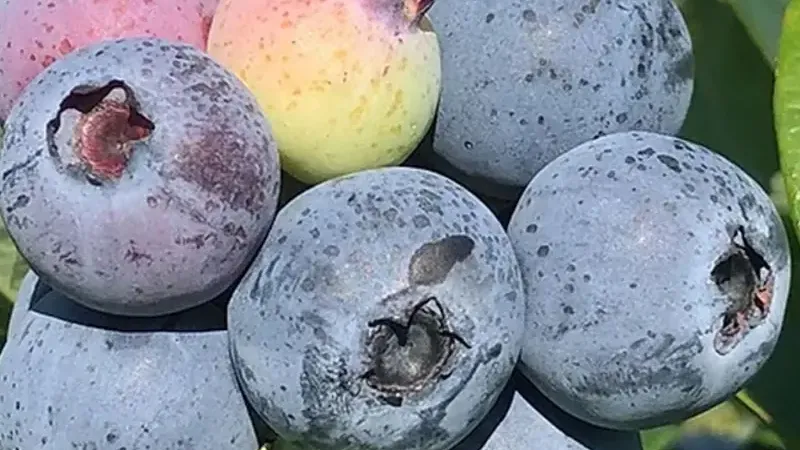
Imagine finding only hard, gray, wrinkled structures resembling small pumpkins on your bushes instead of juicy blue fruits. This is the work of the fungus that causes the disease known as "Mummy Berry".
A Fascinating Life Cycle
The fungus literally manipulates the plant. In spring, fruiting bodies (apothecia) grow from the overwintered "mummies" on the ground. Spores from them infect young emerging leaves (primary infection). More spores are formed on the leaves along with a sugary secretion that attracts bees. The bees transfer the infection directly into the flowers, where the fungus replaces the seed and creates a new mummy.
Who is at Risk?
For Northern Highbush, this is historically the biggest problem, capable of destroying up to 50% of the crop in a wet year. The 'Bounty' variety is extremely sensitive, while 'Duke' is moderately resistant.
For Half-high varieties (e.g., 'Northblue'), snow is a problem – it maintains moisture on the ground, in which the fungi from the mummies easily germinate in spring.
For Lowbush, it is an epidemic. Continuous carpet-like stands create ideal conditions for spreading. Traditional field burning was once an effective prevention.
Part III: Silent Killers – Viruses and Phytoplasmas
While we can see fungi, viruses work in hiding. Symptoms like mild yellowing or deformities are easily confused with nutrient deficiencies. When they manifest fully, the plant must be destroyed.
NHB: The Epicenter of Viruses
Northern Highbush suffers the most. The Blueberry Shoestring Virus (transmitted by aphids) deforms leaves into shoestring shapes and halves the yield. The Blueberry Scorch Virus causes sudden dieback of flowers (blight). Only strict vector control (aphids) and planting certified virus-free material help here.
SHB: Bacteria from the Tropics
New threats have emerged in the south. Bacterial Leaf Scorch (Xylella fastidiosa) is an incurable bacterium transmitted by leafhoppers, causing leaf desiccation. The 'Meadowlark' variety is extremely sensitive to it.
Fun Fact: How Does Rabbiteye Defend Itself?
Rabbiteye varieties face the disease Blueberry Stunt (a phytoplasma causing stunting and a "witches' broom" appearance). They lack immunity, but breeders discovered a brilliant trick. They found that the leafhoppers (which transmit the disease) simply don't like the taste of Rabbiteye (they have a "non-feeding preference"). The insects avoid them, and the plant thus remains healthy.
Overview of the Biggest Threats
| Blueberry Type | Main Fungal Threat | Main Viral/Bacterial Threat |
|---|---|---|
| Northern Highbush | Stem Canker, Mummy Berry | Shoestring Virus, Scorch Virus |
| Southern Highbush | Phytophthora (Root Rot) | Bacterial Leaf Scorch, Necrotic Ring Virus |
| Rabbiteye | Gall Midge (pest) | Blueberry Stunt (Phytoplasma) |
| Lowbush | Mummy Berry, Valdensinia | Red Ringspot Virus |
Conclusion
The fight against blueberry diseases is an endless arms race. Nature, however, always has an answer ready. The genetic diversity of the genus Vaccinium is enormous, and successful cultivation requires a combination of correct agrotechniques (raised beds, airy substrate, collecting fallen leaves and fruits) and high-quality, certified planting material of resistant varieties.
A healthy start is the foundation of success
Choose healthy, certified plants from our offer ➤
Suspect a disease in your orchard?
Join our community and consult with experts and growers.
Join the VIP Facebook group HERE ➤